Explore · historic place of the week · Nov. 6, 2026
Lincoln County Poor House Farm: the county’s farm home for people in need
A county farm home from 1874 to 1960, about 8.5 miles southwest of the Fayetteville square as the crow flies.
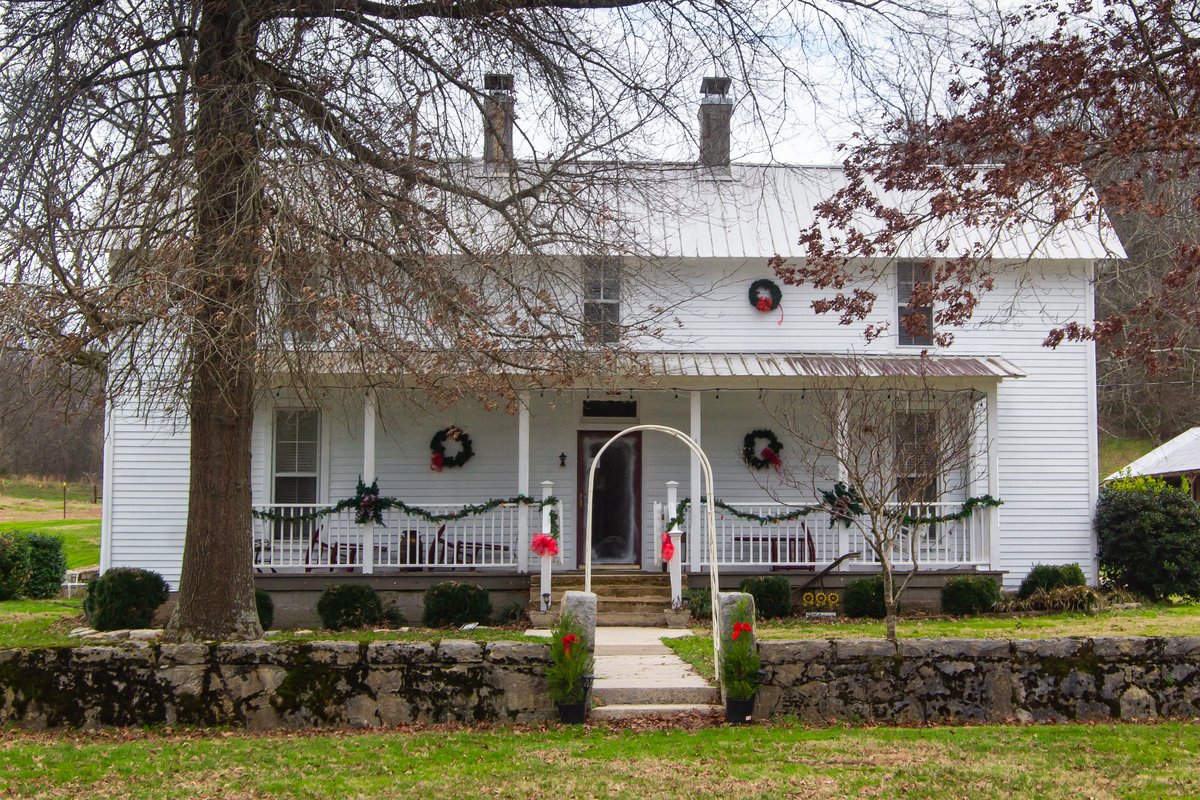
Along Poorhouse Road in southern Lincoln County, in a valley the 1985 nomination calls Poorhouse Hollow, stands a two-story frame farmhouse. From 1874 until 1960 this was the Lincoln County Poor House Farm, where the county gave people in need a home and a place to work. It was added to the National Register of Historic Places on July 11, 1985.
Source: National Register nomination: Lincoln County Poor House Farm (1985, PDF) · NPS National Register record 85001511 · Wikipedia: National Register listings in Lincoln County, Tennessee (listing date)Visit
- Where
- Poorhouse Road, near Taft in southern Lincoln County. The two markers stand side by side on Poorhouse Road about 1.7 miles east of Good Hollow Road, on the right when you are heading west (per HMdb). Use the map pin.
- Getting in
- Private property. The farmhouse is a private home and the graveyard is on private land, so read the markers and enjoy the view from the road. Please don’t go up the drive, onto the lawn or into the fields, and don’t go looking for the cemetery.
- Where to stand
- At the two markers on the road shoulder. The farmhouse faces the road, so you can see the front porch from there.
- Parking
- This is a rural road with no parking that we know of. Pull fully off the pavement only where the shoulder is firm and you can see traffic both ways; don’t block driveways or farm gates, and watch for farm equipment.
- With kids
- Keep children with a grown-up and away from the road edge while you read the markers.
- How far
- About 8.5 miles from the Fayetteville courthouse square in a straight line.
- Time
- Suggestion: 10 minutes at the markers. It pairs well with a back-roads drive in southern Lincoln County.
- Good to know
- The map pin is the state marker’s location as posted on HMdb and hasn’t been checked in person. We found no parking or restroom information.
Directions (Google Maps) Apple Maps OpenStreetMap
Map point: 35.06718, -86.67962 (the state marker on Poorhouse Road).
Map data © OpenStreetMap contributors. Location: the Tennessee Historical Commission marker’s position as posted on HMdb; not checked in person.
Looking after neighbors, from 1815
According to the 1985 nomination, providing for the poor and needy was one of the first acts of the Lincoln County Court. In 1815 it approved a special tax on landowners to help people in need, and by about 1826 the fund was big enough to buy a farm and put up a log house. Three commissioners appointed by the court ran it, with a full-time superintendent. The nomination does not say where that first farm was.
Source: National Register nomination: Lincoln County Poor House Farm (1985, PDF)A farm home, 1874
On Nov. 17, 1874, the county court bought 293 acres just south of the Yukon community as a farm home for the poor of the county, to be called the Lincoln County Poor House Place. The farm buildings went up soon after, and a cemetery was set aside on the grounds. No record names who built them.
Source: National Register nomination: Lincoln County Poor House Farm (1985, PDF)The farm sits along Dry Creek, about a mile southwest of Yukon and five miles southeast of Coldwater, amid fields the nomination counts among the best land in Lincoln County. (The state marker on the road gives the farm’s size as 230 acres.)
Source: National Register nomination: Lincoln County Poor House Farm (1985, PDF) · HMdb: The Lincoln County Poor Farm (Tennessee Historical Commission marker 3G 38)“Everyone had a job”
From 1874 until 1960 the farm was home to the county’s poor, its elderly, orphans and others who could not care for themselves. Residents raised their own food. Gardens supplied vegetables in summer, and the harvest was canned, dried and stored for winter; wheat and corn were grown for bread.
Source: National Register nomination: Lincoln County Poor House Farm (1985, PDF)The county’s magistrates oversaw the farm. An elected superintendent lived there, directed the farm work and looked after the residents. The state marker on the road sums it up in four words: “Everyone had a job.”
Source: National Register nomination: Lincoln County Poor House Farm (1985, PDF) · HMdb: The Lincoln County Poor Farm (Tennessee Historical Commission marker 3G 38)What the nomination found in 1985
Three main buildings stood along the road. The largest, the superintendent’s house, is a two-story frame house on a native stone foundation, with a standing-seam tin roof and a one-story porch across most of the front, which faces the road.
Source: National Register nomination: Lincoln County Poor House Farm (1985, PDF)Forty yards southeast was a one-story wooden dormitory with twelve small rooms; open latticework at the tops of the walls let air move through. The farm was segregated: the nomination describes that dormitory as housing white residents, and a smaller house uphill, probably built in the early 1900s, as housing Black residents. A root cellar and a springhouse stood just behind the superintendent’s house.
Source: National Register nomination: Lincoln County Poor House Farm (1985, PDF)In 1985 the dormitory was stable but somewhat worn, and the smaller house was in poor condition. We have not seen what remains today.
Source: National Register nomination: Lincoln County Poor House Farm (1985, PDF)Remembering those buried here
The farm’s graveyard is across the road, on private land, and no names remain on its graves. Accounts of its size differ. The 1985 nomination counts approximately fifty graves on the ridge. The Tennessee Historical Commission marker says some 100 people who died at the farm are buried on the hillside 500 yards northwest of it.
Source: National Register nomination: Lincoln County Poor House Farm (1985, PDF) · HMdb: The Lincoln County Poor Farm (Tennessee Historical Commission marker 3G 38)The Lincoln County Historical Society’s marker, beside it, says its rocks were placed as a memorial for about two hundred people buried in a grass lot 500 yards northwest, and that upright rocks mark the cemetery’s boundary.
Source: HMdb: Poor Farm Cemetery (Lincoln County Historical Society marker)After the farm
In 1959 the county court passed a resolution to borrow money to build an Old Folks Home in Fayetteville, with the farm to be sold to pay off the debt once the new home was finished. The farm was leased in 1960 to a former superintendent and passed into private ownership in 1961.
Source: National Register nomination: Lincoln County Poor House Farm (1985, PDF)The nomination calls the farm a rare surviving example of a county farm home for the poor in south central Tennessee, and “a good example of an institution that at one time had an important humanitarian role in Lincoln County.” In 1985 the superintendent’s house had just been renovated as a private home. The farm is private property today.
Source: National Register nomination: Lincoln County Poor House Farm (1985, PDF)On the drive: things to talk about
- “Everyone had a job,” says the state marker. If you lived on a farm like this, which job would you pick?
- Summer gardens were canned and dried for winter. What food would you save for the cold months?
- Two markers stand side by side and give different numbers for the graves. Why might old records disagree?
- From the road, find the long front porch on the farmhouse.
Sources
- National Register nomination: Lincoln County Poor House Farm (1985, PDF)
- NPS National Register record 85001511
- HMdb: The Lincoln County Poor Farm (Tennessee Historical Commission marker 3G 38)
- HMdb: Poor Farm Cemetery (Lincoln County Historical Society marker)
- Wikipedia: National Register listings in Lincoln County, Tennessee (listing date)
We point to the records; we don’t make up facts. Where a source is old, we say when it was written. Marker texts are summarized from HMdb; the photos there belong to their photographers and are not used here.
Know something we got wrong? Tell us
Have a family story or an old photo of Lincoln County Poor House Farm? Email it to us and tell us who took it. We only post photos with the owner’s OK.
Share this page: ourtownalmanac.com/tn/fayetteville/explore/lincoln-county-poor-house-farm/