How money moves in our town
How our town’s economy works
No money, no town? Follow one dollar around Fayetteville.
No money, no town?
Try imagining this: what would Fayetteville look like if money stopped moving for one month? It isn't disappearing, just sitting still. Nobody spends, nobody gets paid, nobody borrows.
Follow it around:
- Paychecks. Employers here paid $389.3 million in payroll in 2023 (Census County Business Patterns). That's roughly $32 million in a typical month (calculated: ÷ 12). Picture that month's checks not arriving.
- Shop shelves. A shop can't restock if nothing sold. What's on the shelf in week one? By week four?
- Farm sales. Lincoln County farms sold $196.0 million of crops and livestock in 2022 (USDA Census of Agriculture), about $16 million a month on average (calculated). Real farm sales come in waves around harvest and sale days. What happens to cattle and crops that are ready when nobody is buying?
- Bank loans. The county's FDIC-insured branches held $798.1 million in deposits on June 30, 2026 (FDIC Summary of Deposits). If nobody deposits or borrows, what happens to a farmer's spring seed money?
- Sales tax for schools and the library. The county's local option sales tax brought in $8,061,337 in FY2025 (TN Dept. of Revenue; see By the numbers), about $672,000 a month (calculated). Part of it goes to schools by state law (TCA 67-6-712). We didn't pull a figure for how the library is funded.
- Church and club donations. Offering plates, bake sales and booster clubs all run on money that moves. We have no local figure for this, so we don't use one.
Questions to sit with:
- What would you notice first?
- What would keep going without money? What wouldn't?
- Who would feel it soonest: a shop, a farm, a family or a school?
Pairs with Picture the square without its shops. That activity removes the shops. This one keeps the shops and stops the money.
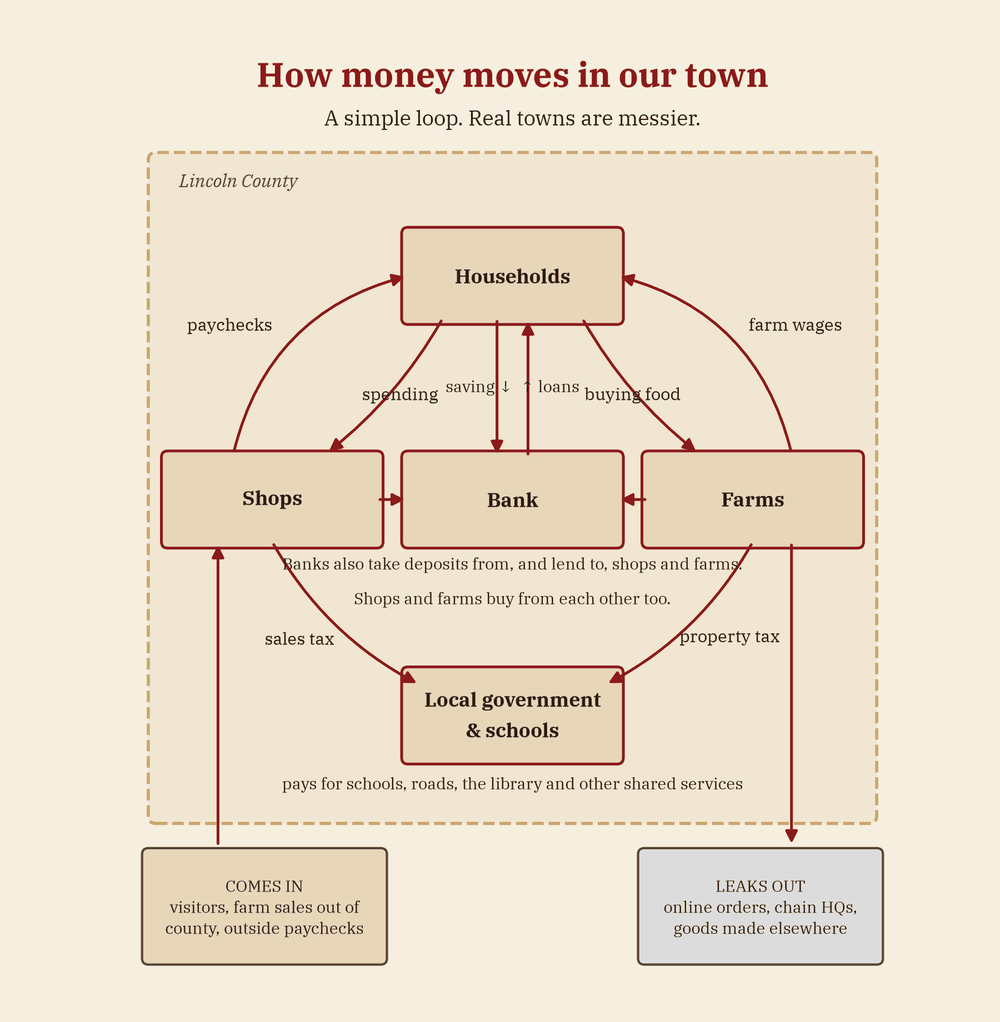
Follow one dollar
- You spend $1 at a shop on the square. Sales tax goes with it (see Follow the $20).
- Part of that dollar pays the person who rang you up (Where does your paycheck come from?).
- Part pays the shop's supplier. That might be a farm down the road, or a warehouse far away.
- The owner deposits what's left at a bank, and the bank lends some of it out, maybe to a farmer (What does a bank actually do?).
- The worker spends part of the paycheck in town. Maybe it buys a hamburger, maybe it goes toward rent (What does a bank actually do?, Buying a place).
- If the item had been stolen instead, none of these steps would happen (When something walks out the door).
- Each time the dollar is spent somewhere else in town, the loop keeps going. When it's spent with a business elsewhere, it leaks out.
Big ideas, in kid words
| Idea | In kid words | Here in Lincoln County | What do you notice? |
|---|---|---|---|
| Trade | I give you something, you give me something, and we both think we came out ahead | 68 county farms sold directly to people in 2022, for $1.12M (Census of Ag.) | At a farm stand, what does each side get? |
| Prices | What it takes to get something. It goes up when lots of people want it and there isn't much of it | — | Why might strawberries cost more in December? |
| Profit and loss | What's left after paying for everything. A loss is when it's less than zero | Farm expenses here were $153.3M in 2022 against $196.0M in sales (Census of Ag.) | Is a big sales number the same as a big profit? |
| Savings and loans | Money set aside, and money borrowed now and paid back later | $798.1M in deposits at county branches (FDIC, 2026) | Whose savings might be in a loan to a shop? |
| Taxes for shared things | Everyone chips in for things everyone uses | 25¢ of every $20 sale goes toward schools (see By the numbers) | What did you use today that tax paid for? |
| Specialization | Each person does one kind of job well and trades for the rest | 628 employer businesses and 2,718 one-person businesses (Census, 2023/2024) | How many people did it take to make your lunch? |
| Risk | Doing something that might not work out | 364 of 628 employers have 1–4 staff (2023) | Who loses if a new shop doesn't make it? |
| Competition | Sellers trying to win buyers by being better, faster or cheaper | — | When two shops sell the same thing, what changes? |
| Circulating vs. leaking | Money that stays and gets spent again here vs. money that leaves | First Saturdays draw an estimated ~38,500 visits (Main Street's own estimate) | When visitors spend here, which way is the money moving? |
Definitions, from teaching sources
- Voluntary exchange: "Voluntary exchange occurs only when all participating parties expect to gain." (Council for Economic Education, Voluntary National Content Standards in Economics, Standard 5, https://www.councilforeconed.org/wp-content/uploads/2012/03/voluntary-national-content-standards-2010.pdf)
- Specialization: "When individuals, regions, and nations specialize in what they can produce at the lowest cost and then trade with others, both production and consumption increase." (CEE Standard 6.) And in a K–5 glossary: "working in a specific job producing a specific good or service while relying on other workers to produce other goods and services." (Georgia Council on Economic Education, https://www.gcee.org/sites/main/files/file-attachments/ga_k-5_econ_glossary___0.pdf)
- Markets and prices: "A market exists when buyers and sellers interact. This interaction determines market prices and thereby allocates scarce goods and services." (CEE Standard 7)
- Competition: "Competition among sellers lowers costs and prices and encourages producers to produce more of what consumers are willing and able to buy." (CEE Standard 9)
- Money: "Money makes it easier to trade, borrow, save, invest, and compare the value of goods and services." (CEE Standard 11)
- Profit: "Money earned in excess of what it costs to produce goods and services." (Junior Achievement glossary, https://sites.google.com/ja.org/ja-econ-resources/home/glossary)
Recheck these quotes against the CEE PDF before printing. They were read through FTE's and the Minneapolis Fed's reproductions of the standards.
Market Day in Our Town (pretend game)
Players: 5 to 12. Time: 20–30 minutes. ALL MONEY IS PRETEND.
Cut out: 40 paper $1 bills and 10 paper $5 bills (label each "PLAY MONEY · Our Town Almanac"), plus goods cards: 10 "Tomatoes," 10 "Eggs," 6 "Shirts," 6 "Lemonade."
Roles:
- Farmer (1–2 players): starts with all the Tomatoes and Eggs cards and $5.
- Shopkeeper (1–2): starts with the Shirts and Lemonade cards and $5. Can buy from the Farmer to resell.
- Banker (1): starts with $30. Takes deposits and makes loans. Writes each one on a slip: who, how much, and when it's due back.
- Customers (2–6): each starts with $8 of "paycheck."
- Town Clerk (1): collects $1 of sales tax for every $5 of sales, keeps a tally, and at the end "spends" it on a shared town thing the group picks, like a park bench or library books.
Rounds:
- Market opens. Customers buy. Sellers set their own prices and may change them.
- Payday. Each Farmer and Shopkeeper pays $2 to one Customer, who is their helper. Can they afford it this round? If not, they can visit the Banker.
- Bank time. Anyone can deposit or ask for a loan. The Banker decides.
- Leak card. The leader draws: "A customer orders something online. $2 leaves town; put it in the Out-of-Town box."
- Repeat for three rounds.
At the end, count up and talk:
- Where did most of the money end up?
- What happened on the round when money leaked out?
- Did anyone borrow? Why, and did they pay it back?
- What did the Town Clerk's tax buy? Who used it?
- What would you do differently in another game?