Teach yourself · Fayetteville
Learn from our shops and farms
What do you notice? What’s missing? What could you make better?
This page is for Fayetteville kids who want to learn how a real business works, and for the parents, grandparents and teachers who bring them along.
Every shop on the square and every farm in the county is a small business. Someone paid for everything on the shelves before it sold. Someone pays the workers every week, even after a slow one. You can learn a lot just by paying attention on everyday trips:
- Look around. What do they sell? Who’s buying? Is anything missing?
- Ask one friendly question when they aren’t busy, like “How did you get started?”
- Tell us what you learned. Write it or draw it, and email it to hello@ourtownalmanac.com.
Shops and farms don’t sign up for anything, and there’s nothing to schedule. Kids just visit and ask, the way any customer would.
Teach yourself
Read. Learn. Build skills that serve.
Your learning belongs to you. Here are some places to start in Fayetteville.
Read
Learn
- Question notebookNotice, ask, find, write it down, teach it
- Square DetectiveLook closely at the past
- Ask a shopkeeperFive friendly questions, Business Detective
- Ask a farmerWhat you don’t see on a farm
- Ask a librarianTheir job is helping you find things
Build skills that serve
- Odd jobsRaking, watering, a job ledger
- Spot a needWhat’s hard, slow or forgotten?
- Grow somethingA bucket, some dirt and a sunny spot
- How money movesPaychecks, banks and our town
One way to go looking
- Notice something.
- Ask a question about it.
- Find it. A library book, a librarian, an old letter, map or photo, a person who knows, or your own hands.
- Write it down in your question notebook.
- Teach it to someone else.
Then do it again. Three tries with our own town · Print the question notebook (PDF)
Ask a shopkeeperFive friendly questions for your next normal visit.
Before you ask
- Go with a grown-up. Always.
- Pick a quiet moment. No line? Good time.
- Buy something small if you can. (You don’t have to.)
- Ask one or two questions. Not all of them.
- Busy? That’s OK. Say “Maybe another time!” and smile.
- Say thank you. Every time.
Pick a question
- How did your shop get started?
- Do you remember the very first thing you sold?
- What’s your favorite part about having a shop here?
- What’s a mistake that taught you something?
- What would you tell a kid who wants to start a business someday?
Bonus, only if it feels right: What’s something about your job that customers never see?
What you don’t see
Just notice and wonder. These are for you to think about, not to ask. (Money questions are private.)
- Before the doors open, someone already unlocked, swept, stocked and turned on the lights. Who? When?
- Most of what’s on the shelf was bought by the shop before you could buy it.
- On payday, who gets paid first: the helpers or the owner?
- Count the hours on the door sign. Now guess how many hours the owner really works.
- Rent and the light bill are due even after a slow, rainy week.
- What jobs happen after the sign flips to “Closed”?
After you ask, write it down
Shop or farm I visited: ______
What I asked: ______
What they said (in a sentence): ______
One thing it made me wonder: ______
Any answer is a good answer, even “not today.”
Local farmsWhere a lot of what we eat, and a lot of Lincoln County’s story, starts.
Farms are businesses too, run by people who put in work long before anything is ready to sell. Lincoln County has a long farm story: our walking tour notes that the Borden milk plant on Main Ave. S., built in 1927, bought milk from more than 1,200 farmers at its peak. (Visit the museum in the old milk plant.)
What you don’t see on a farm
Notice and wonder; you don’t need to ask.
- Seed, feed and fuel are bought long before anything is ready to sell.
- Animals need care every day, on holidays and in bad weather too.
- One storm, a dry spell or a late frost can change a whole season’s work.
- When a machine breaks at harvest time, someone has to fix it fast.
- What has to happen before food gets to a store shelf or a market table?
Ask a farmer (optional)
- What does a day on your farm start with?
- What do you grow or raise, and when is it ready?
- What kind of weather worries you most?
- What’s something you learned the hard way?
- What would you tell a kid who wants to farm someday?
All optional. Ask only where a farmer is already selling to the public, like a market table or a farm stand, and only if they have a minute.
Where farms already show up on our site: the Farm, Equipment & Agriculture listings and farm events, when they’re on, on the events page.
Lincoln County farms by the numbers
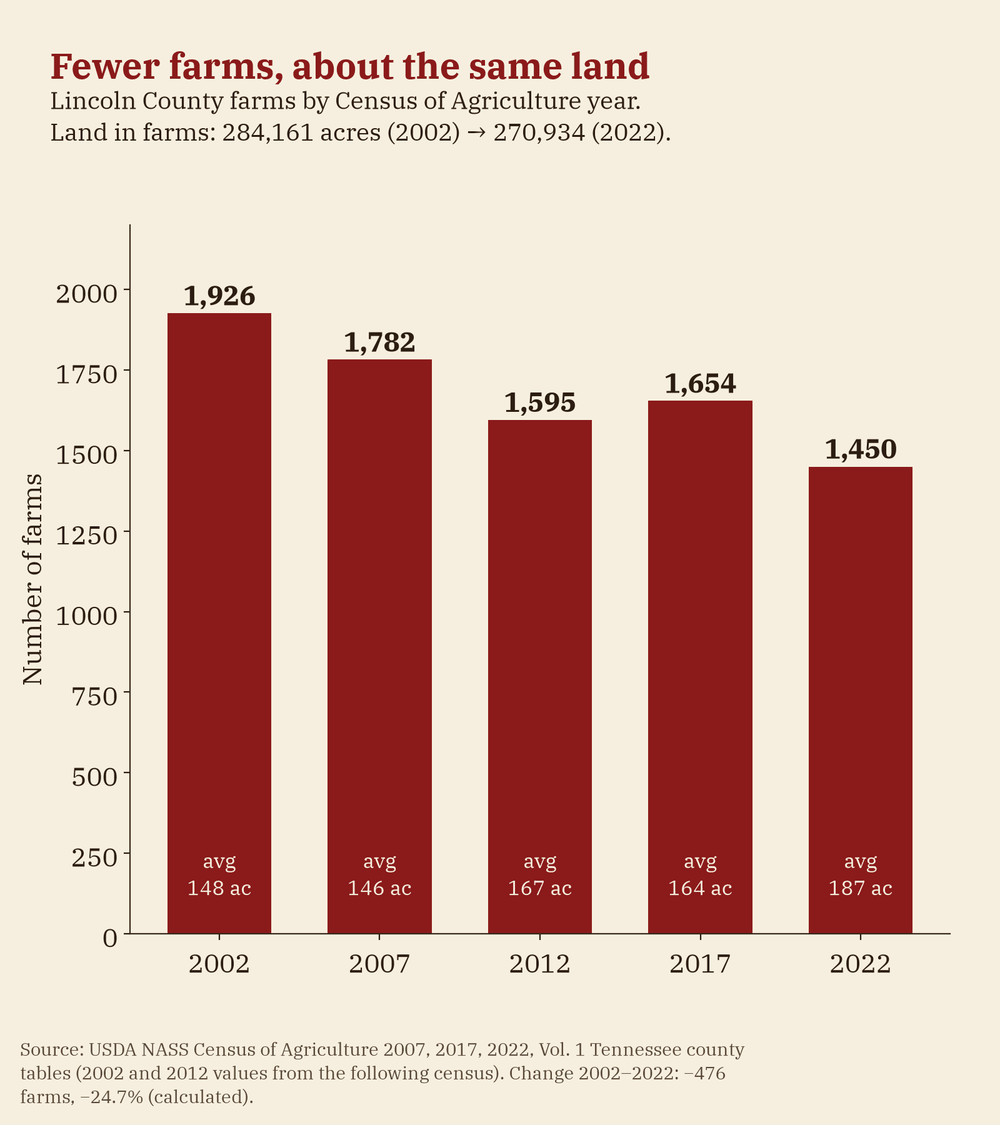
- $196.0 million in farm products sold in 2022, 4th in Tennessee. Livestock and poultry were 71%, crops 29%.
- Cattle and calves: $49.4 million, 1st in the state. Poultry and eggs: $87.7 million, 3rd.
- About 74% of the county’s land area is in farms.
- 2,481 producers, average age 59.0. 629 are new and beginning producers, and 158 are under 35.
- 68 farms sold food straight to consumers, $1.12 million in all (up from 64 farms and $429,000 in 2017).
- 58% of farms sold under $10,000 of products (calculated), and 123 farms sold $100,000 or more.
- Production expenses: $153.3 million. Net cash farm income: $48.8 million, or $33,661 per farm on average, an average that a few large farms pull upward.
Across the U.S., farms peaked at 6.81 million in 1935; there were 1,900,487 in 2022. In 2024, 86% of family-farm households earned more than half their income off the farm.
Sources: USDA NASS Census of Agriculture, 2022 Vol. 1, 2022 County Profile, 2017 and 2007 Vol. 1 (2002 and 2012 values come from the following census) · USDA ERS, 1935 peak · NASS, 2022 U.S. count · ERS, America’s Farms and Ranches at a Glance, 2025 Edition. Dollar figures are not adjusted for inflation.
Grow up farming: paths, projects and the Farm Detective drive →
Business Detective walkA noticing walk on the square. From the sidewalk, with a grown-up; no one needs to stop and talk.
Square Detective looks at the past. Business Detective uses the same habit on today’s shops: look closely, say what you see, back it up, look again.
- Window detective. Stand outside a shop window. What’s going on in this window? What do you see that makes you say that? What more can you find? Start tiny (one price tag, one sign), then widen out to the whole window, the building, the side of the square.
- Who’s it for? What do they sell? Who are they selling to? How can you tell?
- Price detective. Find two similar things at two prices. What’s different about them? Guess what goes into a price: what the shop paid, rent, wages, the time it took, the sales tax.
- Count, then estimate. Count the customers who walk into one shop in 10 minutes (don’t block the door). About how many in a whole day? What might you be leaving out?
- How do we know? Find a sign that says “best,” “original” or “since ____.” Who’s making the claim? How could we check it?
- Imagine it. Draw one side of the square as it looks today. Then draw it again with every shop gone. What changed?
Say it like a detective
I think… this shop mostly sells to people buying gifts.
Because I saw… ribbon, gift bags at the counter, a sign that says “We wrap.”
That matters because… you only need wrapping if it’s for someone else.
But maybe… some people buy for themselves and just like pretty bags.
What would you do?One owner puzzle a week. Talk it over at dinner.
This week’s puzzle
Payday week
You run a shop with two helpers. Friday is payday, and they’re counting on that money. But it was a slow week, and after you pay them, there’s almost nothing left for you. What do you do this week? And what could you try so next week goes better?
Tell us your plan and one reason why.
Tap for “the answer”
There’s no single right answer. Real owners face choices like this, and they don’t all choose the same way.
- What would you do? Say your plan out loud.
- What makes you say that? Give one reason.
- What else could you try? Think of one more idea, then ask: but maybe… why might it not work?
- Who gets paid first in your plan? Who waits? How would each person feel?
A grown-up can send your plan to hello@ourtownalmanac.com. We share two or three answers in the next newsletter (first names only, and kids only with a parent’s OK).
More “What would you do?” puzzles
- The rainy Saturday: it’s pouring, and nobody’s walking the square. What do you do today?
- The price rise: the company you buy from just raised its price. Do you raise yours, keep it and earn less, or find another supplier?
- The new competitor: a shop selling some of the same things opens down the street. What do you change, and what do you keep the same?
- The big order: a customer wants 50 of something you’ve never made 50 of. Say yes? What could go wrong?
- Payday or the big order? Payday is Friday. This week you also have to pay for the holiday stock you ordered. You don’t have enough for everything right now. What do you pay first? Who could you talk to? What could wait?
- The long day: your shop closes at 5, but there’s still ordering, sweeping and the books, and your family has a ballgame at 6. Stay late, hire help (that costs money), or close an hour earlier (fewer customers)? What do you give up?
Each one ends the same way: tell us your plan and one reason why.
What it takesFor families: read this one together.
Every shop on the Fayetteville square has rent, stock and payroll to cover before it earns anything for the owner. The article walks through what owners put up, where a $20 sale goes, and what the town gets back, from public sources.
Read “What it takes to keep a shop open” →
Picture the square without its shops
Close your eyes and imagine walking around the square, but every shop is gone. Dark windows. Locked doors. Talk it over at the dinner table:
- What would you miss first?
- Where would you go for the things you buy there now?
- Where would you get your first job?
- Who would sponsor the team, print the banner, or donate the raffle prize?
- Where would people bump into each other and say hi?
- What would a visitor think of our town?
- Which shop would you most want to bring back, and why?
The full pictureHow one shop reaches the whole town, and where your money goes when you spend it here.
One shop, widening rings
Imagine one shop on the square. When it opens its door in the morning, who does that reach? Follow the question outward, one ring at a time. Some rings can be counted, some can only be noticed, and some only come out as stories.
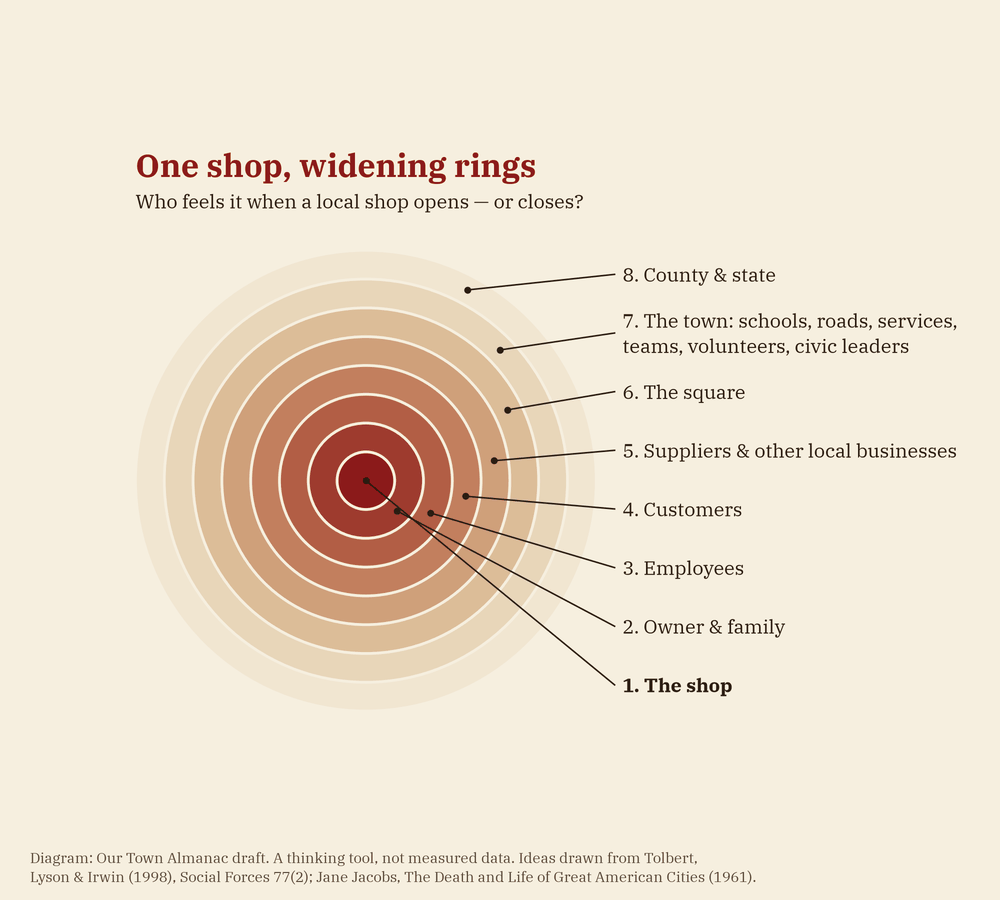
| Ring | A Lincoln County number that fits |
|---|---|
| 1. The shop: its rent, stock, risk | 628 business locations with paid staff; 364 of them have 1–4 people (CBP 2023) |
| 2. Owner & family | 2,718 businesses with no employees at all (Nonemployer Statistics 2024) |
| 3. Employees: paychecks, first jobs, learned skills | 8,514 paid jobs in mid-March (CBP 2023) |
| 4. Customers | No local count. Observable |
| 5. Suppliers & other local businesses | No local count. Study figures under “Follow the $20” |
| 6. The square: foot traffic, lit windows | About 38,500 visits to the 2025 First Saturdays Outdoor Market (Fayetteville Main Street’s own estimate, not a measured count) |
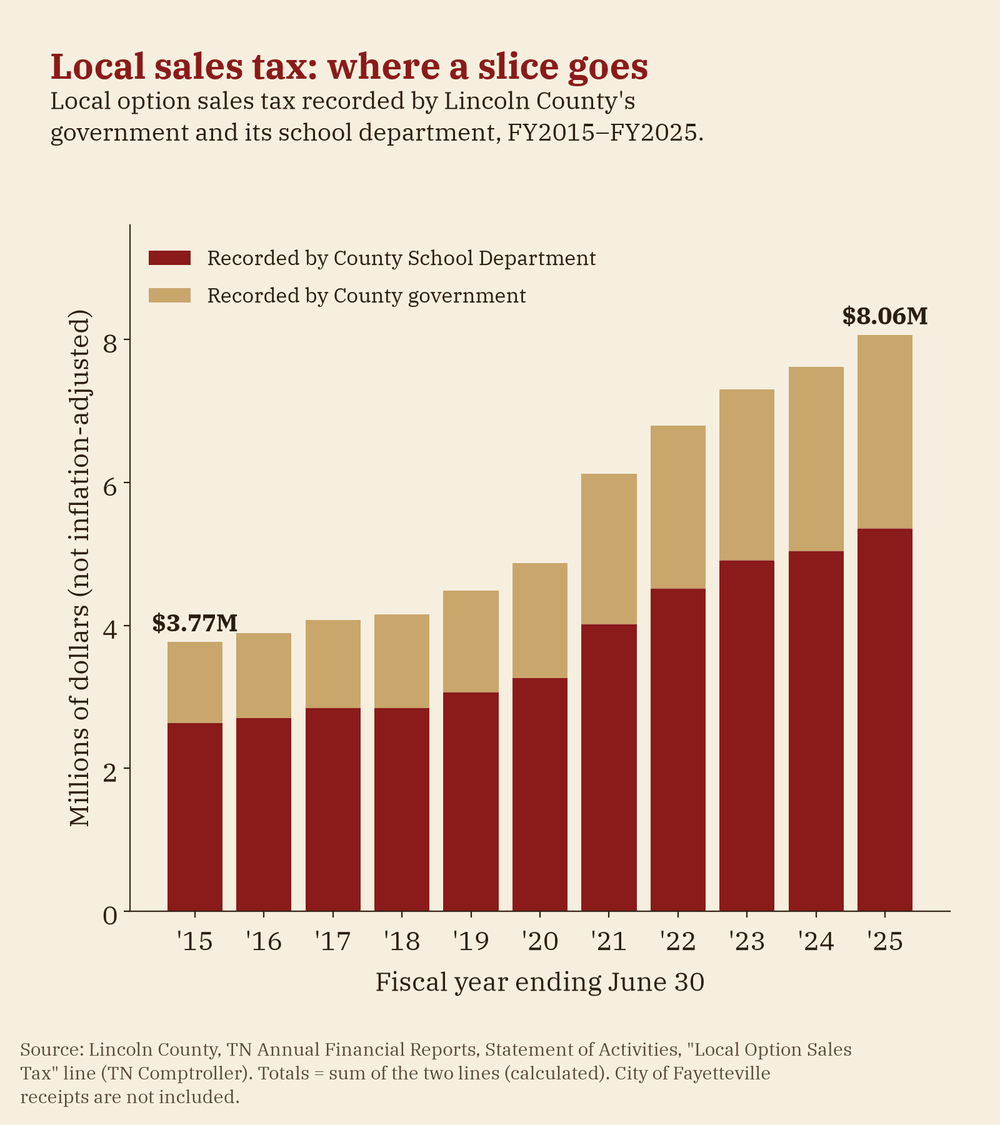
| 7. The town: schools, roads, services; teams; volunteers | $8.06M local sales tax recorded by county government and schools, FY2025 (Lincoln Co. AFR) |
| 8. County & state | State sales tax rate 7% (TN Dept. of Revenue) |
Look for it
- Find a flyer or a business card for another local business on a shop’s corkboard. Who is helping whom?
- Sit somewhere on the square for 15 minutes. How many people stop to talk who didn’t come in together?
- Look at the back of a ballpark fence, a church bulletin or a school program. How many local business names can you find?
- Walk the square twice, once at noon and once near closing. Count lit windows each time.
- Next time you’re in a shop, notice everything the owner had to pay for before you walked in: lights, shelves, stock, sign.
Who pays for all this? A shop’s lease, stock and payroll come first. For SBA-guaranteed loans, the federal rule reads: “Holders of at least a 20 percent ownership interest generally must guarantee the loan” (13 CFR 120.160(a)). Who takes the loss in a slow month?
Sources: U.S. Census Bureau, County Business Patterns 2023 and Nonemployer Statistics 2024 · Fayetteville Main Street, First Saturdays 2025 (the organization’s estimate) · Lincoln County Annual Financial Report FY2025 (TN Comptroller) · TN Dept. of Revenue, Sales and Use Tax. More on each kind of impact: What it takes.
Follow the $20
You spend $20 at a shop on the square. Where does it go? Part pays back what the shop paid for the item. Part goes to rent, power and insurance. Part goes to wages. Part is sales tax, which the shop collects and sends to the state. What’s left, if anything, is the owner’s pay and the cushion for a slow month.
This is the general shape, not figures from any business.
Follow the $20: what we know, and what we don’t
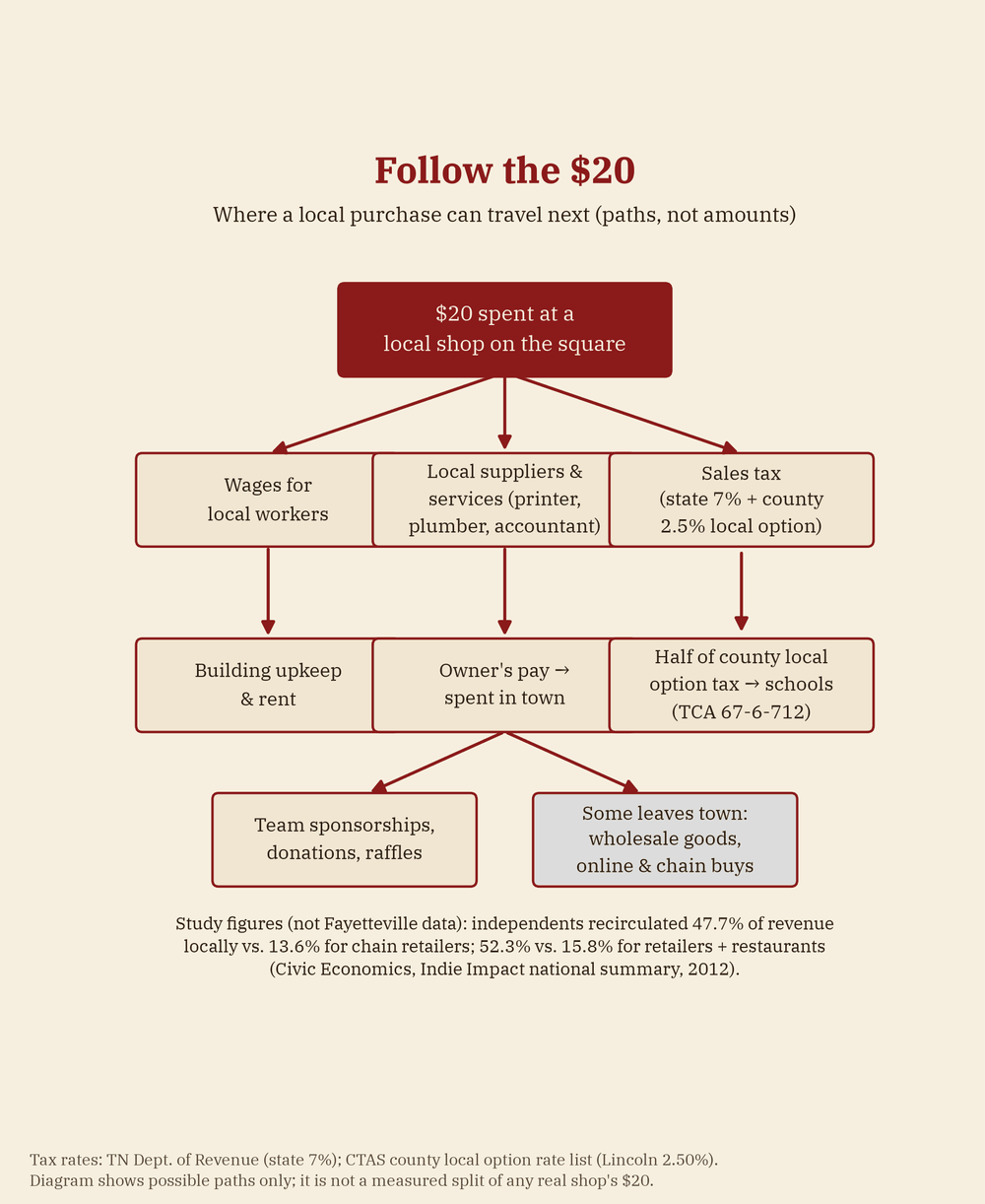
What we know for sure (Lincoln County, from laws and rates)
- Tennessee sales tax is 7%, and Lincoln County’s local option rate is 2.5%.
- On a $20 purchase: $1.40 state, $0.50 local, $1.90 total (calculated).
- Half of the county local option tax goes to schools by law (Tenn. Code Ann. § 67-6-712), so 25 cents of that $20 sale heads toward schools (calculated).
What a national study found (not Fayetteville data)
The consulting firm Civic Economics studied independent businesses in several U.S. communities with the American Booksellers Association, and compared them with public figures from chain retailers.
- Independent retailers recirculated 47.7% of their revenue in the local economy, vs. 13.6% for chain retailers.
- Independent retailers and restaurants together: 52.3% vs. 15.8%.
These are study figures from participating businesses that volunteered their data, in places other than Lincoln County. No one has measured a Fayetteville shop this way.
One way it could go: an illustrative example, NOT real data
If a shop on the square kept the same share as the study’s average independent retailer, then 47.7% of $20 is about $9.54 that recirculates locally (calculated). How that splits among wages, local services, upkeep and giving differs for every shop, so we leave it as a blank to think about, not a number.
Try this: draw the path
- Draw the square in the middle of your page. Put a star on a shop where your family spends money.
- Draw an arrow from the shop to each place you think part of the $20 could go next: someone’s paycheck, a local plumber or printer, the school, the building, a ball team’s jersey.
- Color the arrows that stay in town one color, and the arrows that leave town another.
- The 25-cent box: On every $20, 25 cents of the county’s sales tax goes to schools. How many $20 purchases would buy one new library book? (Ask your librarian what a book costs.)
- Draw the online version. Where do the arrows go?
- Which drawing has more arrows staying in town? (No right answer. Just look.)
Sources: TN Dept. of Revenue, Sales and Use Tax (state 7%) · CTAS county sales tax list (Lincoln County 2.50%) · Tenn. Code Ann. § 67-6-712 · Civic Economics, Indie Impact Study Series national summary, as reported by Bookselling This Week, Jan. 17, 2013, archivenews.bookweb.org · AMIBA, “The Local Multiplier Effect”.
By the numbers: Lincoln County
Numbers from the U.S. Census Bureau, USDA and Lincoln County’s audited financial reports. Dollar figures are not adjusted for inflation. Sources below.
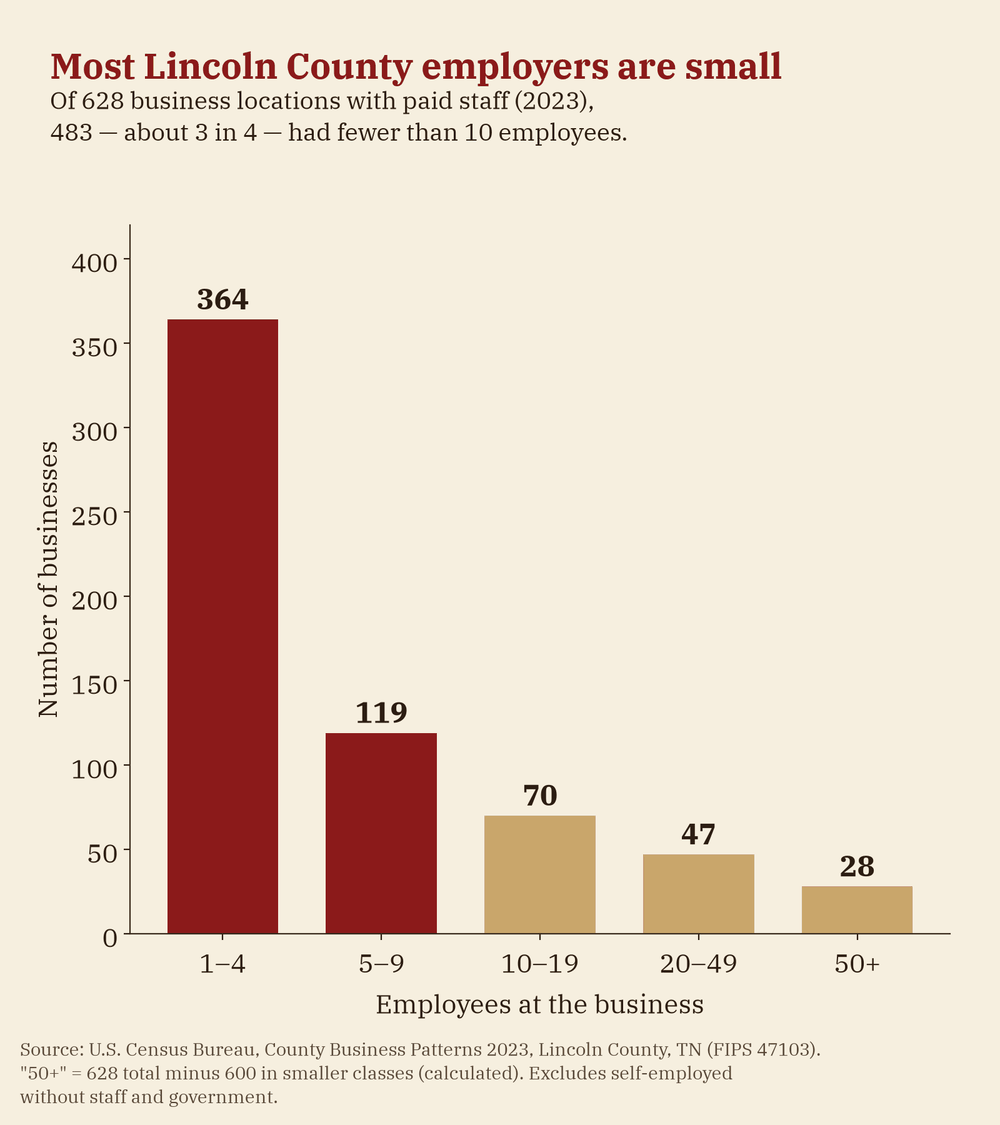
- Most of our employers are small. Lincoln County had 628 business locations with paid staff in 2023. 364 of them had 1 to 4 employees, and about 3 in 4 had fewer than 10.
- Lots of people are their own boss. Another 2,718 businesses had no employees at all in 2024: one person, sometimes with family helping. That’s about 4 for every business with staff.
- Jobs came back. Paid jobs dropped from 9,230 in 2019 to about 6,500 in 2020 and 2021. By 2023 they were back to 8,514.
- A few cents of every purchase stays to help schools. On a $20 purchase, the county’s 2.5% local sales tax is 50 cents. By state law, half of that, 25 cents, goes to schools.
- Those cents add up. In the year ending June 2025, Lincoln County’s government and school department recorded $8.06 million in local sales tax together. Ten years earlier it was $3.77 million.
- Farms are 3/4 of the map. About 74% of the county’s land is farmland. Lincoln County farms sold $196 million of products in 2022, 4th in Tennessee, and the county sold more cattle than any other county in the state.
- Fewer farms, about the same land. There were 1,926 farms in 2002 and 1,450 in 2022. The land in farms barely changed, so the average farm grew from 148 to 187 acres.
- The average farmer here is 59. 629 people counted in 2022 were new or beginning farmers.
Square Detective: questions to take downtown
- Count the shops on one side of the square. How many look like they have fewer than 5 people working? How could you check without asking?
- Look at a receipt from a local shop. Can you find the sales tax line? Using the numbers above, how much of it might reach a school?
- How many buildings on the square have a year carved, painted or posted on them? Which is the oldest you can find?
- Next time you drive out of town, count the fields, pastures and woods you pass. Does “3/4 of the land” look right to you?
Sources: U.S. Census Bureau, County Business Patterns 2019–2023 (counts only businesses with paid employees; jobs are a mid-March snapshot) and Nonemployer Statistics 2024 · Lincoln County Annual Financial Reports FY2015 & FY2025 (TN Comptroller) · Tenn. Code Ann. § 67-6-712 · CTAS county sales tax list (Lincoln County 2.50%) · USDA NASS Census of Agriculture 2002 & 2022. “About 3 in 4”, “about 4 for every” and the 25 cents are our own arithmetic on those figures.
How money moves in our townPaychecks, a stolen $20 item, banks, and the whole loop.
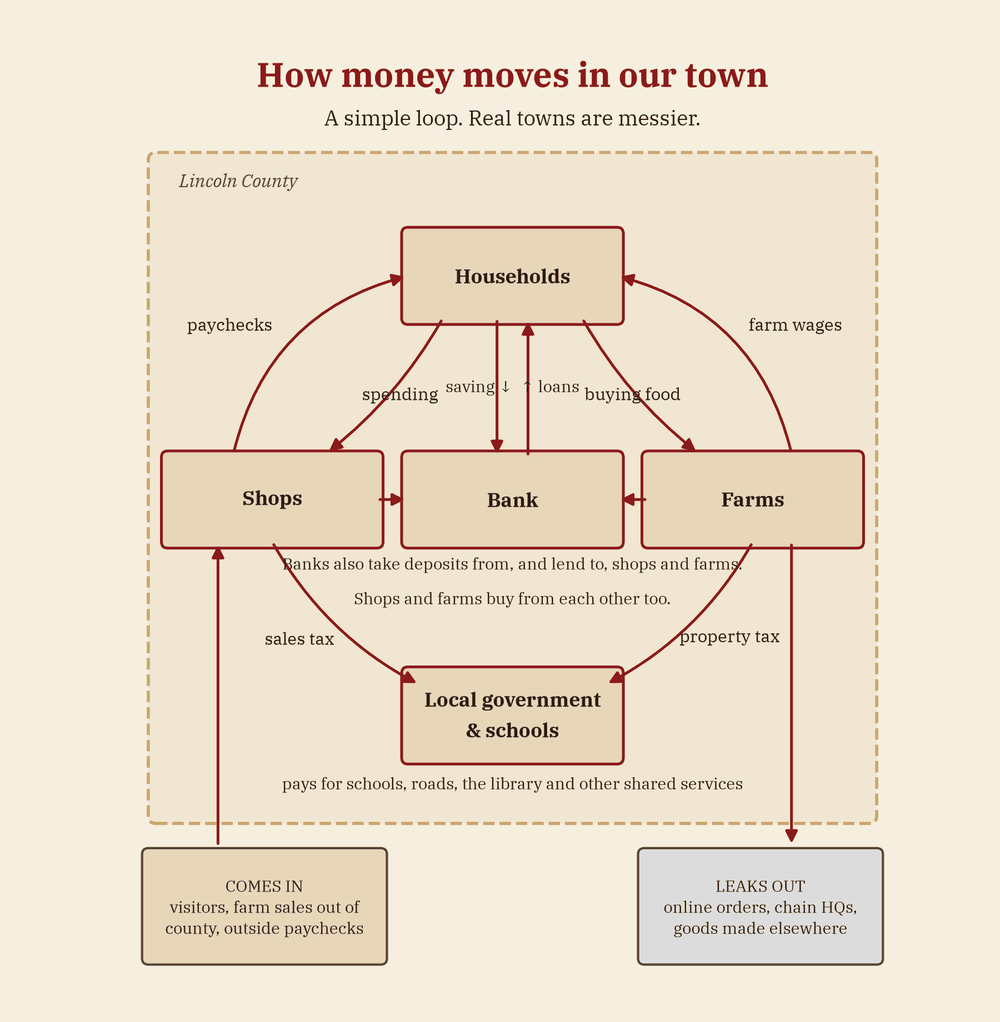
Where does a paycheck come from before it's in your hand? What happens when something walks out a shop door, what does a bank do with savings, and how do people buy land or a home here? These pieces show how it works, with real numbers where we have them and pretend numbers where we don't. They aren't advice. Look, count and decide what you notice.
Where does your paycheck come from?
Payday usually doesn't wait for sales. Owners often pay from money already collected, savings, or a line of credit. On top of your pay, the employer owes its own 6.2% Social Security and 1.45% Medicare (IRS, 2026), plus federal and Tennessee unemployment taxes. Most Tennessee employers with 5 or more workers also must carry workers' comp. In Lincoln County, 364 of 628 employers have 1 to 4 people on payroll (Census, 2023). Try the "Follow one day's sales" puzzle, then look at your next stub. What do you notice?
When something walks out the door
A shop keeps only a slice of each sale as profit. At a pretend 5% margin, earning back one stolen $20 item takes $400 in sales. Big U.S. retailers' net margins run about 1.3% to 7.8% (NYU Stern, Jan. 2026). Nationally, retailers reported shrink of 1.6% of sales in FY2022, with external theft about 36% of it (NRF, 2023). A stolen item also carries no sales tax, so the 25¢ for schools on a $20 sale never arrives. Why are some things kept behind the counter? Who pays when something walks out the door?
What does a bank actually do?
Savers deposit money, and the bank lends much of it out: to a family for a house, a shop for stock, a farm for seed. Interest flows both ways, and the difference helps run the bank. That's 3.32% industry-wide in Q2 2026, with 0.57% of loans charged off (FDIC). Deposits are insured up to $250,000 per depositor, per bank, per ownership category (FDIC). Community banks held 36% of small-business loans and 70% of farm loans at year-end 2019 (FDIC). Lincoln County's 10 FDIC-insured branches held $798.1 million in deposits on June 30, 2026. Try the Town Bank puzzle. If everyone saved at a bank 500 miles away, where might the loans go?
How our town’s economy works
No money, no town? Try picturing Fayetteville if money stopped moving for one month. In 2023, employers here paid about $32 million a month in payroll (Census, calculated). The county's local sales tax brought in about $672,000 a month in FY2025 (calculated), part of it going to schools. Follow one dollar from the register to a paycheck, a supplier, a bank and back. Some of it stays and gets spent again here, and some leaks out. Try the Market Day game with play money. What do you notice?
Tell us what you learnedKids’ words, shared with a grown-up’s OK.
Tell us what you learned. A grown-up can email it to hello@ourtownalmanac.com. First name and age, or no name at all. We never publish family names.
Send: the shop or farm (business name only), what you asked, what they said in a sentence, and what it made you wonder. Say “Yes, you can share this.” We fix spelling only, never share photos of kids, and never name owners or staff. We might share the best ones in the newsletter.
StickersHonor system: do it, then print or save your sticker.

Your libraryThe Fayetteville-Lincoln County Public Library, 306 Elk Ave. N.
A card is free for residents, and some things there don’t need one. Hours, programs and free e-books.
- Card: “A FLCPL library card is issued FREE to all Fayetteville and Lincoln County residents.” Bring “A government-issued photo ID, with the correct name and address.” The card page doesn’t say how children sign up, so bring your grown-up and ask at the desk. (Library card page)
- With a card: books, audiobooks and movies, plus e-books and audiobooks on the Libby app (Libby / Tennessee R.E.A.D.S.).
- No card needed: the Tennessee Electronic Library and TEL4U (“Homework help, games”), and the Genealogy Room: “The Genealogy Room is located on the 2nd floor of our library.”
- Hours and storytime: see flcpl.org or our Libraries page, and call (931) 433-3286 to confirm.
Who pays for the library?
Lincoln County’s audited financial report says: “The Fayetteville-Lincoln County Public Library is a joint venture of Lincoln County and the city of Fayetteville and is operated by an appointed board.” It also says: “Lincoln County contributed $132,202 to the operations of the library during the year ended June 30, 2025.” (Lincoln County FY2025 Annual Financial Report, Tennessee Comptroller) We haven’t yet found the city’s share in a source.
What do you notice? Next time you borrow a book, think about the shelves, the lights, the computers and the people at the desk. Who do you think pays for each one?
Get to know your librarians, plus an Ask a librarian card
Librarians are the people whose job is helping you find things. Try this:
- Pick a calm moment. If the desk is busy, browse a while and try again.
- Say hi and your first name. Next time, they may remember you.
- Bring one real question. “I liked Black Beauty. What should I read next?” gives them something to go on.
- Try the catalog yourself first (online catalog), then ask for help with the part you couldn’t find.
- Come back and tell them how the book was.
- Say thank you.
Pick a question
- “I just finished ___. Can you help me find another book like it?”
- “How do I find a book on the shelf from the catalog number?”
- “Where would I look to learn how to ___?”
- “Do you have old newspapers or maps about Fayetteville?”
- “What did you love reading when you were my age?”
- “How do I get my own library card?”
What you don’t see: Library staff do a lot you may not see: helping people at the computers, answering the phone, getting programs ready.
Tell us (if you’d like): what did you find? Email hello@ourtownalmanac.com with your first name and age only.
You don’t have to ask anything. Just looking around counts too.
From the library’s own pages and the county report linked above, checked Oct. 25, 2026.
More to explore
- Teach yourself, Spot a need and Odd jobs
- Where does your paycheck come from?, When something walks out the door, What does a bank actually do? and How our town’s economy works
- Square stories: Carter’s Drug Store, what the public record says about one of the square’s longest-running shops
- Square Detective: look closely at old photos of the square
- Fayetteville’s longest-running businesses
- The Fayetteville directory
We ask shops and farms for nothing. If an owner ever wants to add something, they’re welcome to write to hello@ourtownalmanac.com.