Our Town Almanac
Fayetteville, Tennessee The Fayetteville Almanacpart of Our Town Almanac · directory, events, history & people · Lincoln County, Tennessee · ZIP 37334

Square Detective

Square Detective

We notice. You tell us.

Every old photo, postcard, map label and newspaper clipping on this page is a clue. So is the square itself. Look first. Ask what’s going on here, what you see that makes you say that, and what more you can find. Then open the answers, and make your case.

A new case each week. The answer comes Friday.

Get the answer in Friday’s email, along with what’s on this weekend. One short email a week, free.

Optional, so we can greet you by name. Only email is required.

We’ll email you a link to confirm; you’re subscribed once you click it. Sent through Brevo, our email service. See privacy.

How to look like a detective

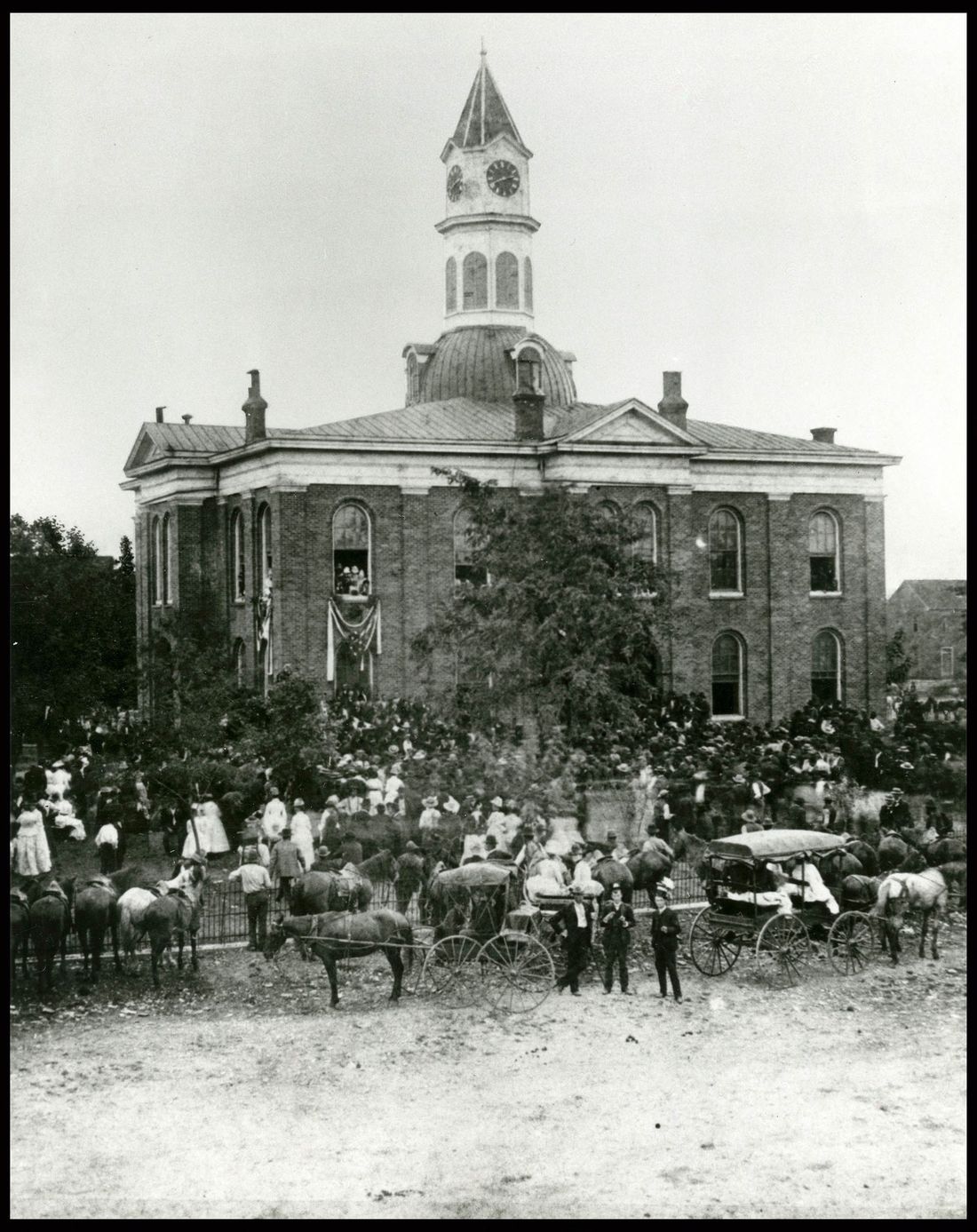
Case #1: The crowd at the courthouse, 1886

A famous photo, a dated archive record, and a few details that don’t quite add up. Look first. Then open the answers.
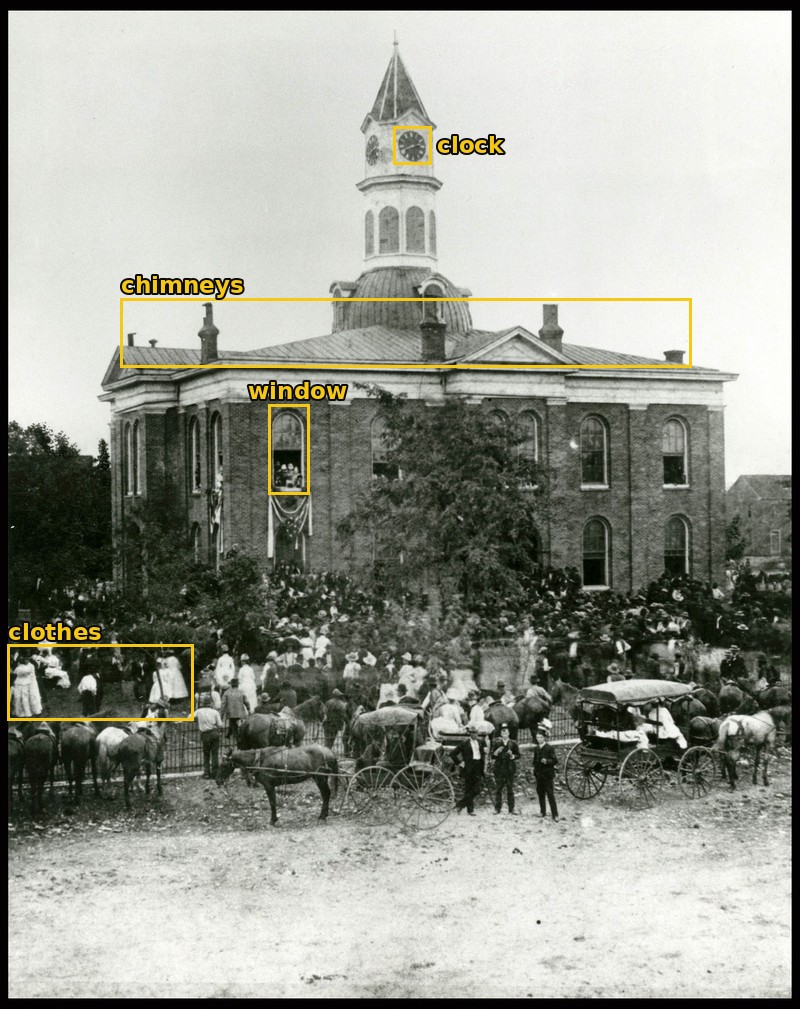
The 1886 photo of a crowd at the old courthouse with four yellow boxes marking where to look: clock, chimneys, window and clothes
Where to look. T. V. McCown, 1886. Tennessee State Library and Archives, Library Photograph Collection. Crop and yellow marks added by Our Town Almanac on a copy; the original is unchanged.
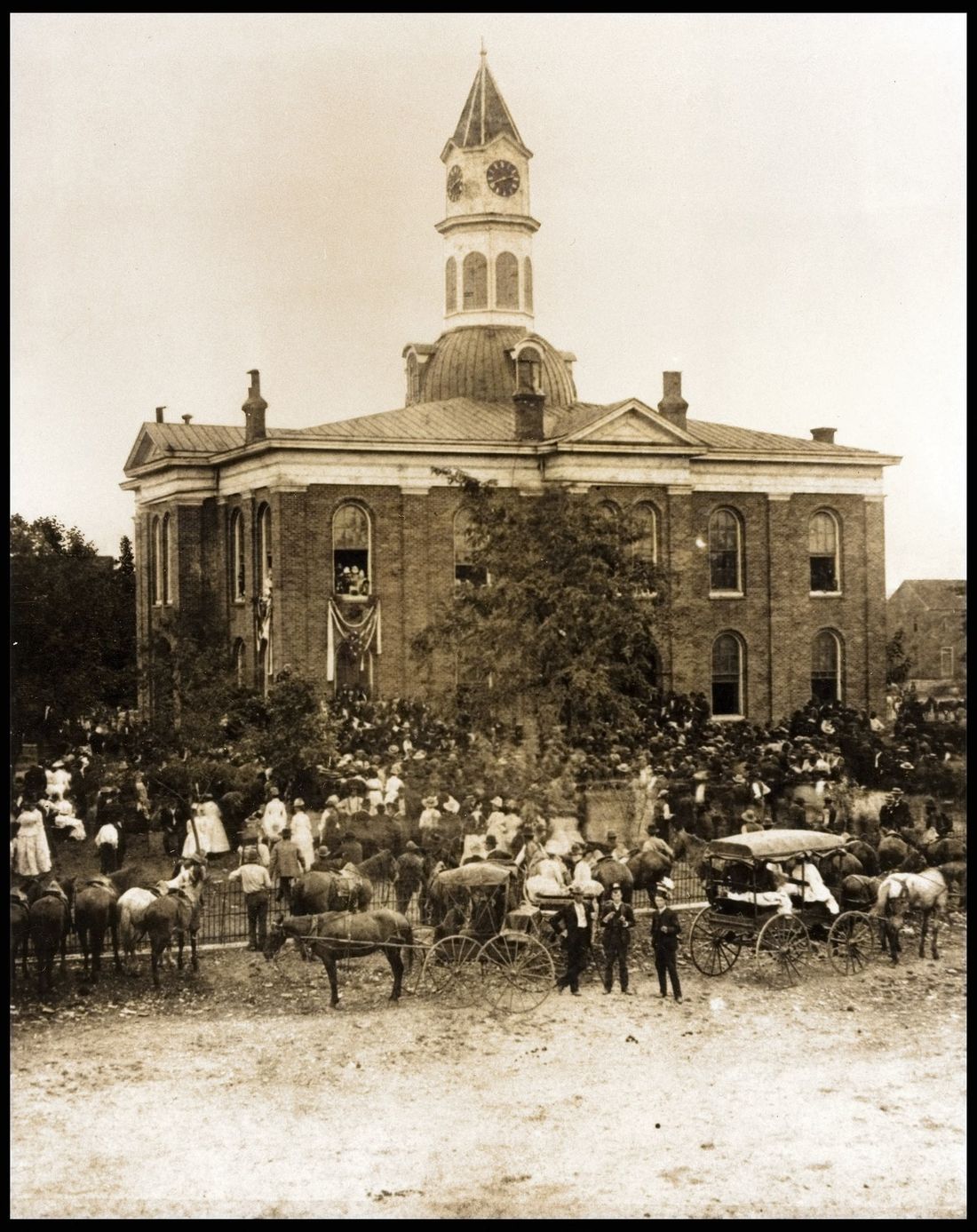
The 1886 photo of a crowd at the old courthouse, colorized
The 1886 photo of a crowd at the old courthouse, original
OriginalColorized
Colorized. Drag the round handle to compare. T. V. McCown, 1886. Courtesy Tennessee State Library & Archives. Colorized by Our Town Almanac; colors are an educated guess. The original is unchanged.

Find the clue

Count the chimneys. How many can you find, and why would a courthouse need so many?
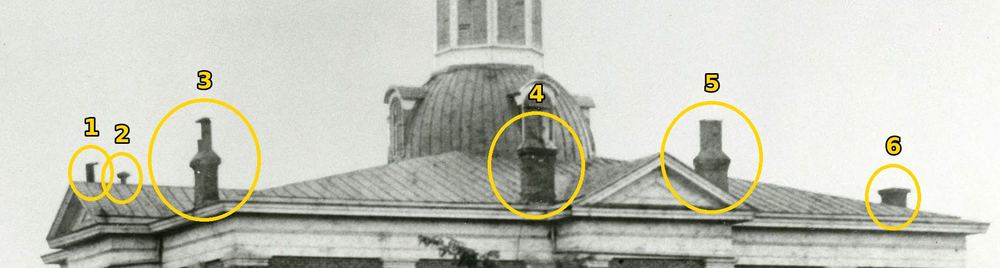
The courthouse roof with six chimneys and pipes circled and numbered
Roof detail, circled and numbered on a copy. T. V. McCown, 1886. Tennessee State Library and Archives, Library Photograph Collection. Crop and yellow marks added by Our Town Almanac on a copy; the original is unchanged.

Find the roofline. Count every stack that sticks up, even the skinny ones.

See the answer
We count six stacks on the roof facing the camera: four brick chimneys and two thin pipes (marked 1–6). The far side of the roof isn’t visible, so there may be more. The 1914 fire-insurance map answers the “why” for this building: its note reads “Heat: stove. Lights: electric.” The same map shows offices in the four corners. Stoves need flues, and for buildings of that era generally, the National Park Service says heat “was primarily from fireplaces or stoves and, therefore, was at the source of delivery,” room by room. Which chimney served which room, we can’t say: no floor plan of the inside has turned up. Confidence: count high for the side we can see; the room-by-room link is a guess.

Source: Sanborn map, April 1914, sheet 9 (Library of Congress) · NPS Preservation Brief 24 (general, not this building)

Dig deeper: How was the courthouse lit in 1914? · The square’s history

What does it suggest?

What time was it? Find the clock on the tower.
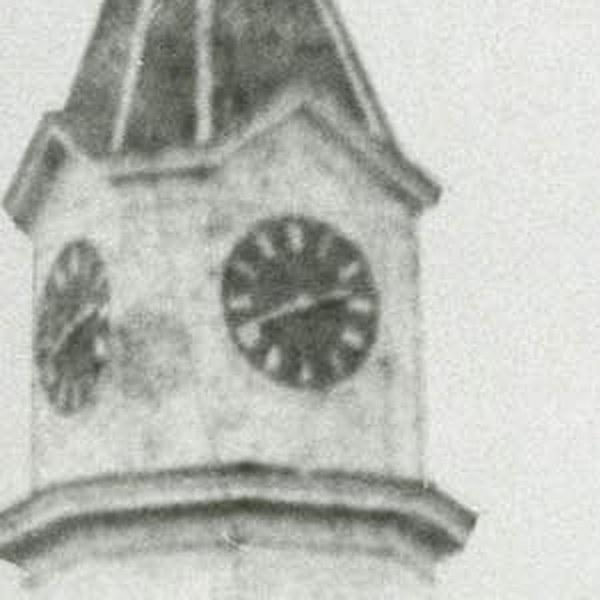
Enlarged clock face on the 1886 courthouse tower
Enhanced: clock enlarged 2× from the archive’s high-resolution scan; no detail added. T. V. McCown, 1886. Tennessee State Library and Archives, Library Photograph Collection. Crop and yellow marks added by Our Town Almanac on a copy; the original is unchanged.

Zoom in on the clock face. Then look down at the street: the parked buggies, the big crowd, the hats and light dresses. Does the clock agree with what you see?

See the answer
The hands make an almost straight line, one near the 2–3 position and one near the 8. That reads as about 2:40 or about 8:10, and even the archive’s largest scan can’t tell the hour hand from the minute hand. Now look down at the street. The whole scene is in bright daylight, too bright for 8:10 in the evening. Buggies with big spoked wheels are parked out front, and a huge crowd in hats and light dresses has already gathered around the courthouse. That looks more like the middle of a busy day than early morning. Our best reading is about 2:40 in the afternoon. Confidence: low to moderate; a busy morning can’t be ruled out.

Source: TSLA high-resolution scan, 2295 px

Dig deeper: What were people wearing? · What time was it on the 1909 postcard?

Open case

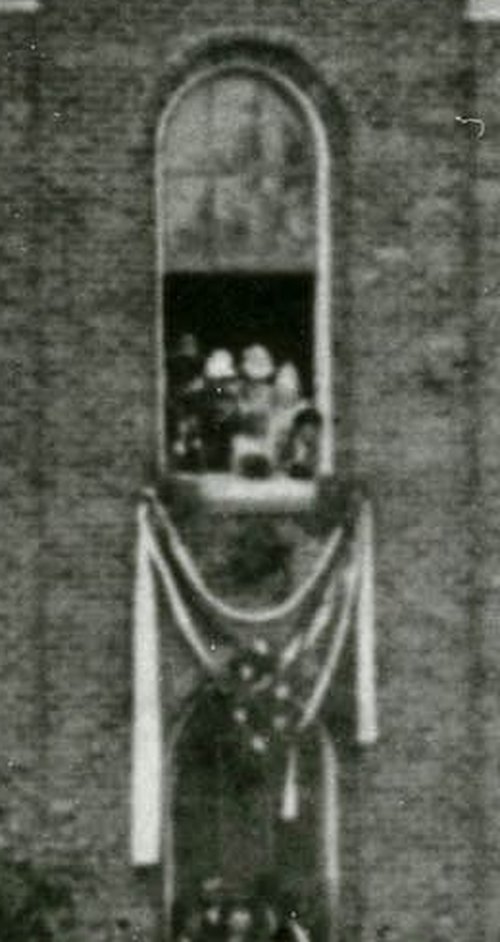
Look up at the second floor. Who’s in the window, and why that window?
A second-floor courthouse window draped with bunting with people looking out
Window detail, enlarged. T. V. McCown, 1886. Tennessee State Library and Archives, Library Photograph Collection. Crop and yellow marks added by Our Town Almanac on a copy; the original is unchanged.

Find the bunting. Then count the faces.

What we know so far
Bunting is draped below one second-floor window, and people are crowded into that window, looking out. The photo’s archive record says the crowd gathered for the 1886 debate between the two candidates for governor, so a decorated window may have been a place of honor. That’s a guess. The record doesn’t say who was in it, and we haven’t found anyone who knows.

Source: TSLA catalog record

Dig deeper: Who was in the windows in 1911? · Tell us if you know

What does it suggest?

What were people wearing? Look at the hats first.
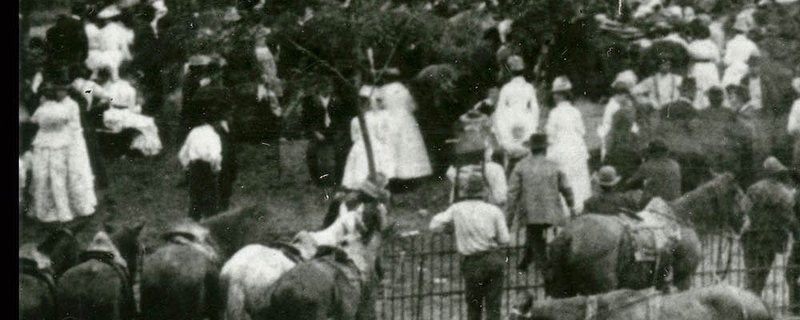
Part of the 1886 crowd: women in light dresses and hats, men in dark suits
Crowd detail. T. V. McCown, 1886. Tennessee State Library and Archives, Library Photograph Collection. Crop and yellow marks added by Our Town Almanac on a copy; the original is unchanged.

Find a woman in a light dress. Look at her hat and the back of her skirt.

See the answer
Nearly everyone wears a hat. Many women wear long, light-colored dresses and wide hats; most men wear dark suits, a few in shirtsleeves. Buggies and saddle horses fill the street, and the trees are in full leaf. What the photo can’t show at this size: whether the women’s skirts have bustles, the big back-projection the Metropolitan Museum says was at its peak in the mid-1880s.

Source: The Met: Nineteenth-Century Silhouette and Support

Dig deeper: Spot the difference: 1886 vs 1911 · Is this really 1886?

Open case

Is this really 1886? The clothes are a clue.

What we know so far
The archive dates the photo 1886 and says it shows the crowd for the Taylor-versus-Taylor race for governor; that campaign’s joint debates opened in September 1886. Full-leaf trees fit a September or October day. But the light dresses and wide hats look a lot like the crowd on the 1911 postcard, and the bustle the Met says peaked about 1885 is hard to find here. We haven’t found a newspaper report of the Fayetteville stop. What do you see that makes you say 1886, or later?

Source: TSLA catalog record · Tennessee Encyclopedia: War of the Roses · The Met: Nineteenth-Century Silhouette and Support

Dig deeper: Compare with the 1911 crowd · Make your case to us

Evidence locker: photo: 1886 courthouse crowd (TSLA) · map label: 1914 courthouse note “Heat: stove” · museum source: The Met on the bustle

Send us your old photo of the square. It could become a Square Detective case. Share a photo or email hello@ourtownalmanac.com. Only send photos you own or have the owner’s OK to share. Tell us how you’d like to be credited (initials, “a reader,” or your name). Loaned photos stay yours.

A new case each week. The answer comes Friday.

Get the answer in Friday’s email, along with what’s on this weekend. One short email a week, free.

Optional, so we can greet you by name. Only email is required.

We’ll email you a link to confirm; you’re subscribed once you click it. Sent through Brevo, our email service. See privacy.

Case #2: The postcard courthouse, about 1909

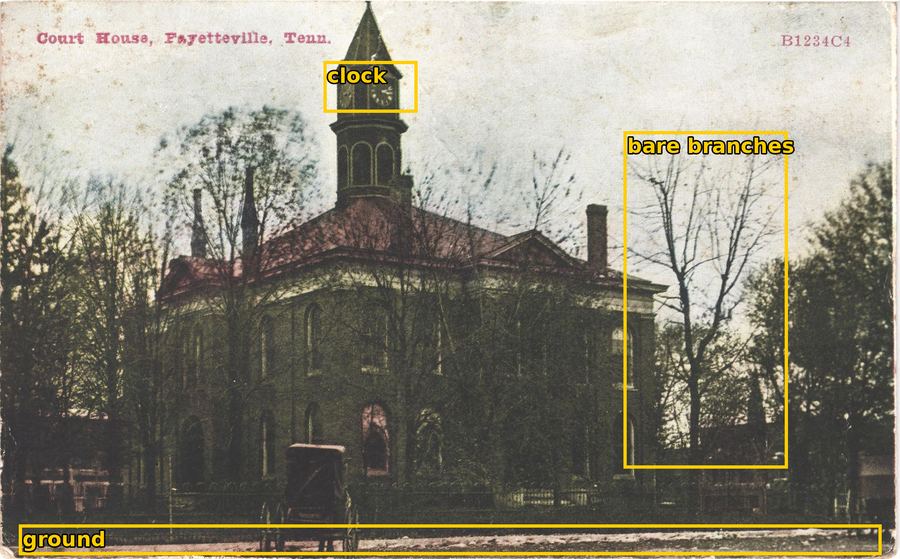
A tinted postcard of the 1874 courthouse. What can a postcard prove, and what might it be hiding?
The c.1909 tinted postcard of the old courthouse with boxes around the clock, bare branches and the ground
Where to look. “Court House, Fayetteville, Tenn.,” H. G. Zimmerman & Co.; postmarked July 31, 1909. Tennessee Postcard Collection, Tennessee State Library and Archives (No Copyright – United States). Marks added on a copy.

Open case

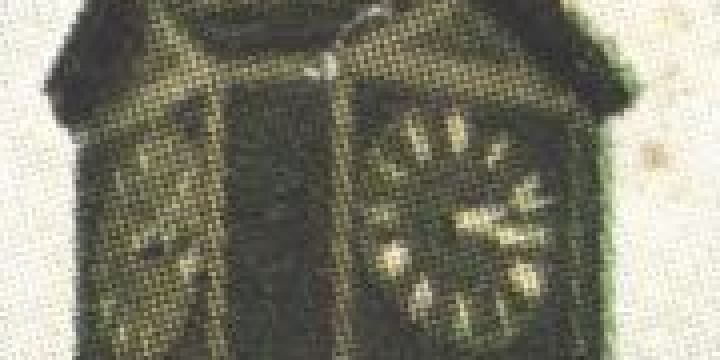
What time does this clock say? Get as close as you can.
The postcard clock enlarged until the halftone dots show
The clock, enlarged: the dots are the printing screen. “Court House, Fayetteville, Tenn.,” H. G. Zimmerman & Co.; postmarked July 31, 1909. Tennessee Postcard Collection, Tennessee State Library and Archives (No Copyright – United States). Marks added on a copy.

Find the tower. Then zoom until the face turns to dots.

What we know so far
Up close, the face breaks into printer’s dots, and the archive’s largest scan is only 1920 pixels wide. We can’t be sure which marks are hands. One more thing to weigh: postcard makers routinely retouched photos, adding clouds, removing wires and sometimes painting in details. So even a readable clock on a postcard might be paint. What do you read?

Source: TSLA postcard record · Postcard Production in America: Retouching

Dig deeper: Read the 1886 clock instead · Tell us what time you read

What does it suggest?

What season was it? What do you see that makes you say that?

Check the branches. Then check the postmark on the back.

See the answer
Look at the trees: bare branches everywhere, so not summer. The ground along the street is pale, which could be snow, dust or the printer’s tint. Now flip the card over: it was mailed on July 31, 1909, in full summer. So the photo was taken in a leafless season, before the card was sent, most likely late fall to early spring. One caution: retouchers sometimes added snow to postcard trees, so the pale ground isn’t proof of snow. Confidence: high for “not summer”; low for snow.

Source: TSLA postcard record (front and back) · swissinfo: retouched postcards

Dig deeper: Spot the difference: 1886 vs 1911 · Old courthouse or new?

Open case

How old was this courthouse when it came down?

What we know so far
About 96 years. Goodspeed’s 1886 county history says the brick courthouse from the 1810s was torn down in 1873 and this one was built by contractors for $39,579.30; it is dated 1874. It stood until about 1970, when today’s Colonial Revival courthouse, the county’s fourth, replaced it. Why it was torn down, and what people said at the time, we haven’t found: the 1960s and 1970s local papers aren’t digitized. Fayetteville Main Street calls it an “unfortunate demolition.”

Source: Goodspeed's History of Lincoln County (1886), p. 772 · Tennessee Encyclopedia: Lincoln County · Fayetteville Main Street, History

Dig deeper: Do you remember the old courthouse? Tell us · How they built it

Evidence locker: postcard: c.1909 courthouse (TSLA tpc1330), front and postmarked back · county history: Goodspeed 1886 · research: how postcards were retouched

Send us your old photo of the square. It could become a Square Detective case. Share a photo or email hello@ourtownalmanac.com. Only send photos you own or have the owner’s OK to share. Tell us how you’d like to be credited (initials, “a reader,” or your name). Loaned photos stay yours.

Case #3: Old courthouse or new?

Two buildings on the same lawn, about a century apart. Look at both, then make your case.

The old courthouse (1874–about 1970)
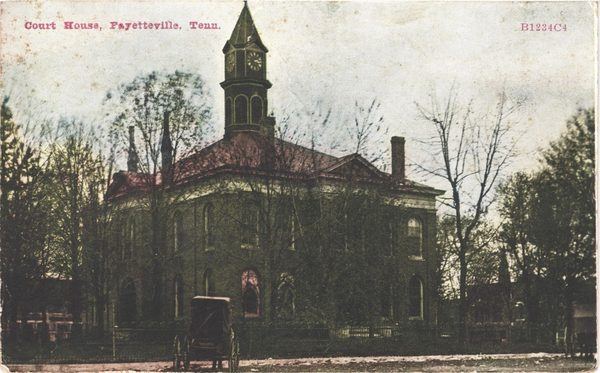
Tinted postcard of the 1874 courthouse with its clock tower
About 1909. “Court House, Fayetteville, Tenn.,” H. G. Zimmerman & Co.; postmarked July 31, 1909. Tennessee Postcard Collection, Tennessee State Library and Archives (No Copyright – United States). Marks added on a copy.
  • A 150-foot clock tower you could see across town
  • Brick, two stories, tall arched windows
  • Chimneys and stoves: “Heat: stove” on the 1914 map
  • Offices in the four corners and a vault

Today’s courthouse (about 1970)
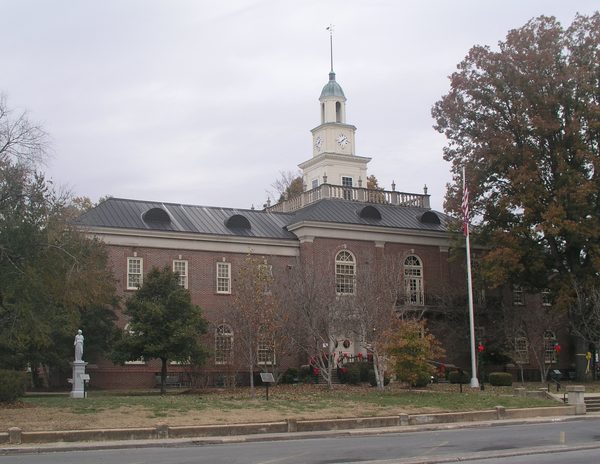
Today’s brick Colonial Revival Lincoln County Courthouse
2008. Photo: Ichabod, CC BY-SA 3.0, via Wikimedia Commons.
  • Colonial Revival, the county’s fourth courthouse
  • Still holds the county offices
  • Built for a modern county government
  • Air conditioning, elevators, room to grow? Tell us what you know.

Make your case

Old courthouse or new? Which would you keep, and why?

What we know, and what we don’t
There’s no right answer here, just your case. Here is what we know for sure: the old one was finished about 1874 for $39,579.30, with a 150-foot clock tower on the 1887 map, and heated by stoves as late as 1914. Today’s was built about 1970. What we don’t know: why the county chose to replace rather than repair, and what the public debate sounded like. If you remember, or have a clipping, we’d love to hear it.

Source: Goodspeed's History of Lincoln County (1886), p. 772 · How they built it (1887 map: 150-foot tower) · Tennessee Encyclopedia: Lincoln County

Dig deeper: Vote: I’d keep the old one · Vote: I’d keep the new one · Draw the square: then and now

Evidence locker: postcard: c.1909 courthouse · photo: 2008 courthouse (Wikimedia Commons) · map label: 1887 “150′ tower” · county history: Goodspeed 1886

Send us your old photo of the square. It could become a Square Detective case. Share a photo or email hello@ourtownalmanac.com. Only send photos you own or have the owner’s OK to share. Tell us how you’d like to be credited (initials, “a reader,” or your name). Loaned photos stay yours.

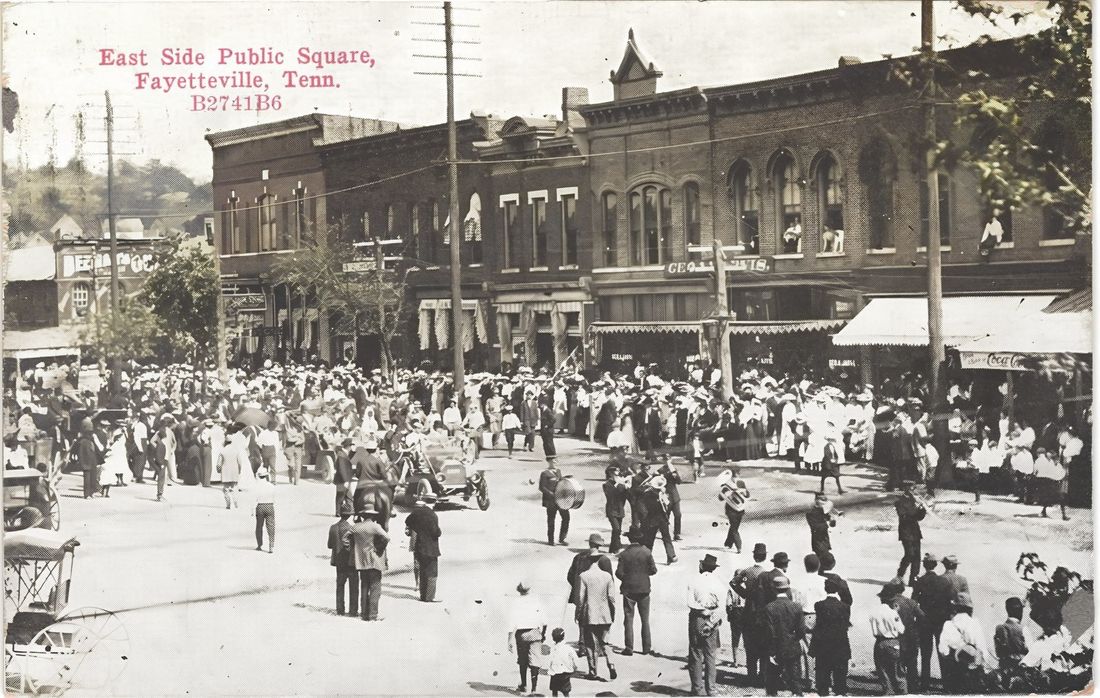
Case #4: The parade on the east side, about 1911

A band, a crowd, a car and a row of storefronts. Scan the edges, then look up.
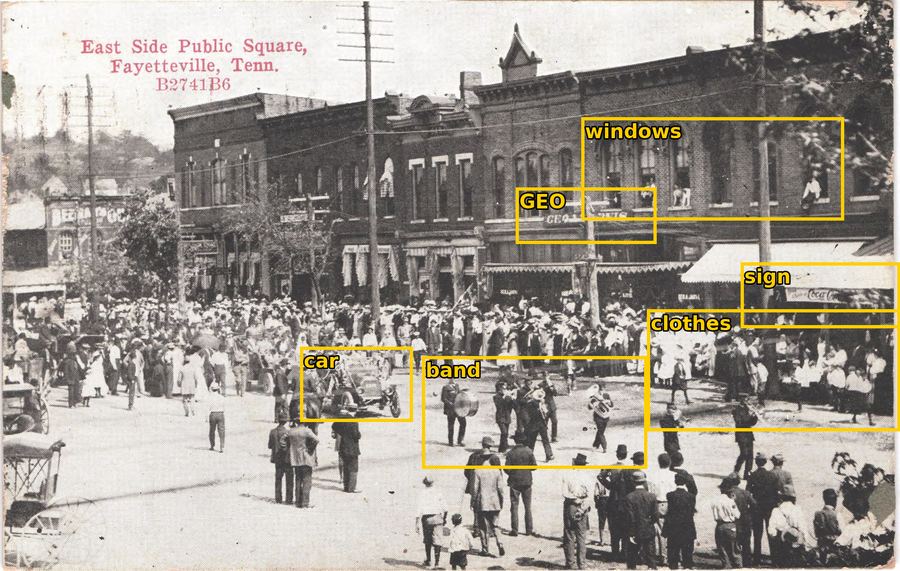
The 1911 east side parade postcard with boxes on the band, car, windows, signs and crowd
Where to look. “East Side Public Square, Fayetteville, Tenn.,” H. G. Zimmerman & Co.; 1911 postmark. Tennessee Postcard Collection, Tennessee State Library and Archives (No Copyright – United States). Crop and marks added on a copy.
The 1911 east side parade postcard, enhanced and colorized
The 1911 east side parade postcard, colorized
The 1911 east side parade postcard, original
OriginalColorizedEnhanced & colorized
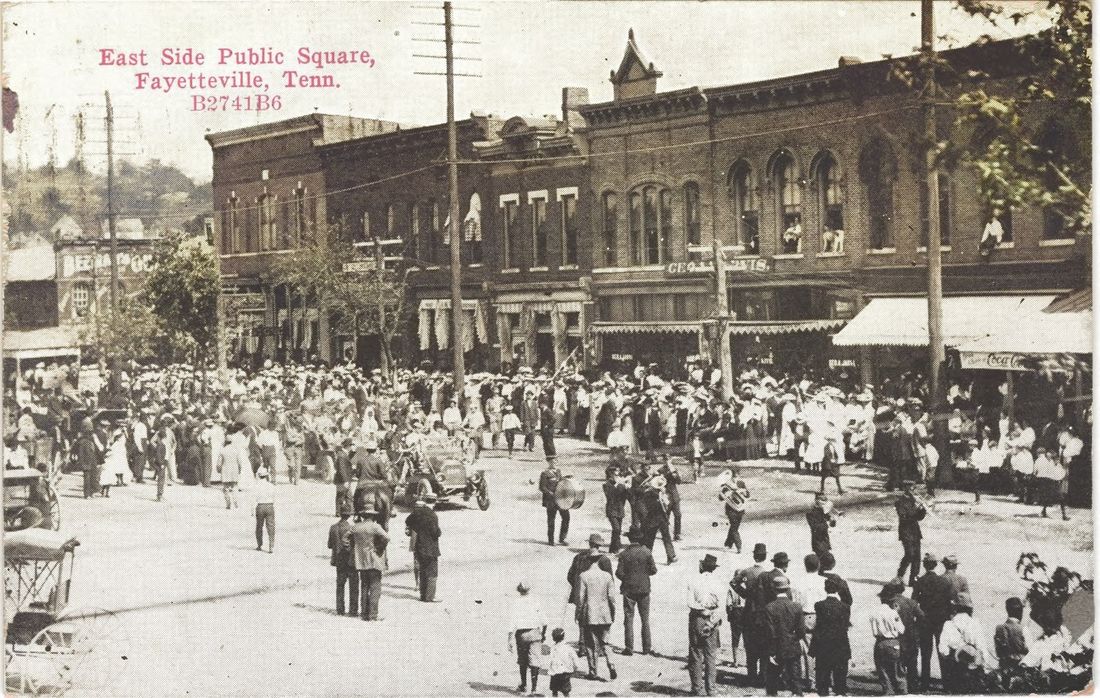
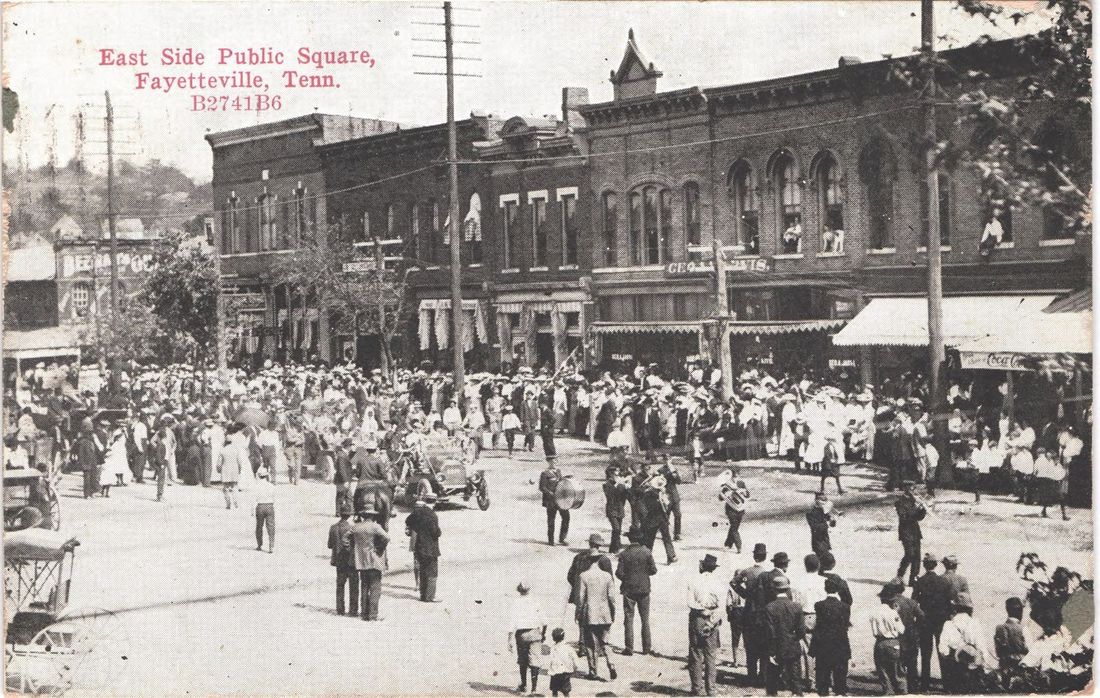
Colorized and enhanced. Drag the two handles to compare: original, colorized, enhanced & colorized. “East Side Public Square, Fayetteville, Tenn.,” postmarked 1911. Tennessee Postcard Collection, Tennessee State Library & Archives (No Copyright – United States). Colorized by Our Town Almanac; colors are an educated guess. The original is unchanged. The enhanced version was enlarged 2× from the archive scan and sharpened, then colorized; faces were not retouched and nothing was drawn in. Sharpening can leave texture that isn’t in the original, so when in doubt, trust the original.

Find the clue

What instruments can you spot in the parade?
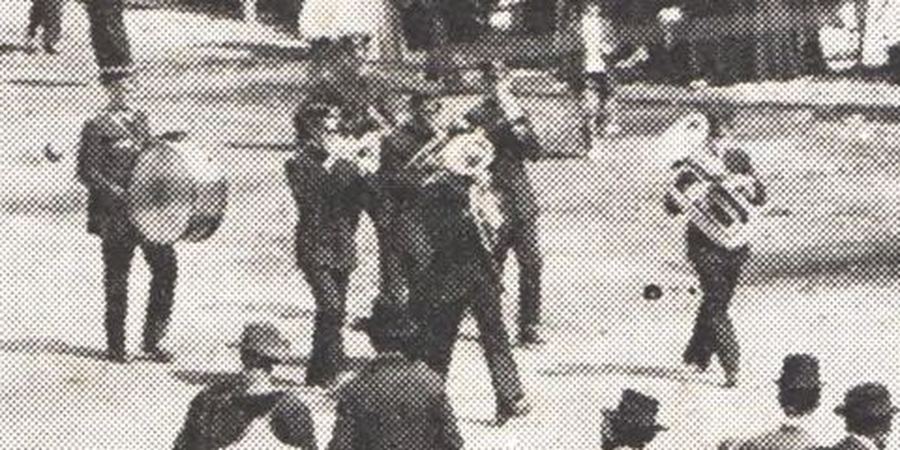
The marching band in the 1911 postcard: a bass drum and several horns
Band detail. “East Side Public Square, Fayetteville, Tenn.,” H. G. Zimmerman & Co.; 1911 postmark. Tennessee Postcard Collection, Tennessee State Library and Archives (No Copyright – United States). Crop and marks added on a copy.

Find the drum first. Then count the bells of the horns.

See the answer
We see a bass drum at the left of the band, a large upright horn at the right (a baritone or alto horn, perhaps), and several smaller horns raised to play, likely cornets, maybe a trombone. The printing dots make anything smaller a guess. Which band it was, the card doesn’t say. Confidence: high for the drum; moderate for the horns.

Source: TSLA postcard record

Dig deeper: Who’s watching from upstairs? · Do you know the band? Tell us

Find the clue

Look up: who’s sitting in the second-floor windows?
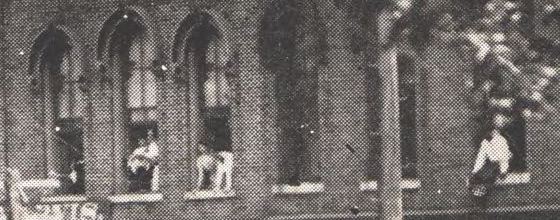
People sitting in the arched upstairs windows of the east side buildings
Upstairs windows. “East Side Public Square, Fayetteville, Tenn.,” H. G. Zimmerman & Co.; 1911 postmark. Tennessee Postcard Collection, Tennessee State Library and Archives (No Copyright – United States). Crop and marks added on a copy.

Scan the arched windows on the right-hand building.

See the answer
At least four people sit on the upstairs window sills, mostly women in white blouses, watching the street. A window seat over the square was the best view in town.

Source: TSLA postcard record

Dig deeper: Who was in the 1886 window? · What were the upstairs rooms used for?

What does it suggest?

What were people wearing? What makes you say that?
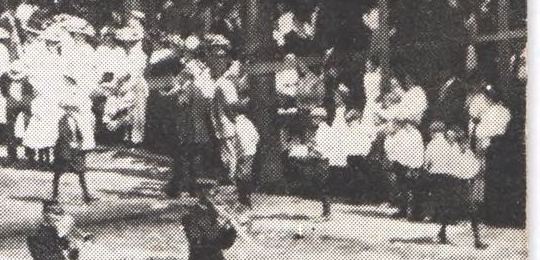
Spectators in white dresses and wide hats along the sidewalk in 1911
Crowd detail. “East Side Public Square, Fayetteville, Tenn.,” H. G. Zimmerman & Co.; 1911 postmark. Tennessee Postcard Collection, Tennessee State Library and Archives (No Copyright – United States). Crop and marks added on a copy.

Pick one woman and one man. Describe the hat, then the outline.

See the answer
Women in white dresses and wide-brimmed hats; men in dark suits with straw boaters and derbies. The Met describes the early-1910s silhouette as slimmer and more columnar than the 1880s bustle line, with the narrow “hobble skirt” of about 1911. Compare it with the 1886 crowd.

Source: The Met: Twentieth-Century Silhouette and Support

Dig deeper: Spot the difference: 1886 vs 1911

Make your case

Spot the difference: 1886 vs 1911. What changed, and what didn’t?

1886 crowd detail
“1886” (TSLA).
1911 crowd detail
1911 (TSLA).
What we know so far
What museums say changed: the Met says the bustle was at its greatest extension around 1885, and that by about 1911 the fashionable line had become slim and columnar. What we can see: both crowds are full of light dresses and wide hats, and both are full of hats on men. What’s new in 1911: an automobile in the street. What we can’t settle: whether the “1886” women really look 1880s. Make your case.

Source: The Met: Nineteenth-Century Silhouette and Support · The Met: Twentieth-Century Silhouette and Support

Dig deeper: Is the courthouse photo really 1886? · What rolled into the parade?

What does it suggest?

Horses or horsepower? Find the odd one out in the street.
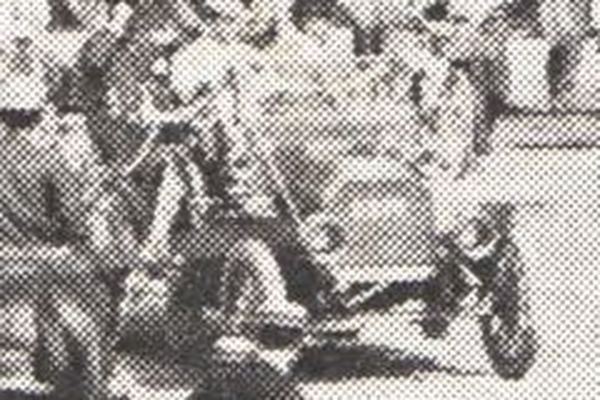
An early open automobile in the 1911 parade
The car. “East Side Public Square, Fayetteville, Tenn.,” H. G. Zimmerman & Co.; 1911 postmark. Tennessee Postcard Collection, Tennessee State Library and Archives (No Copyright – United States). Crop and marks added on a copy.

Scan the left edge, then the middle of the street.

See the answer
An early open automobile rolls behind the band, while a buggy waits at the left edge. Three years later, the 1914 map still lists buggy sales, wagon and grain, harness and feed on the square. The 1926 map labels most storefronts just “S.” (store), so it can’t tell us when the horse trades gave way.

Source: TSLA postcard record · Sanborn map, April 1914, sheet 9

Dig deeper: The square through the decades · What did a harness shop do?

Find the clue

Read the sign under the right-hand awning. What drink is it selling?
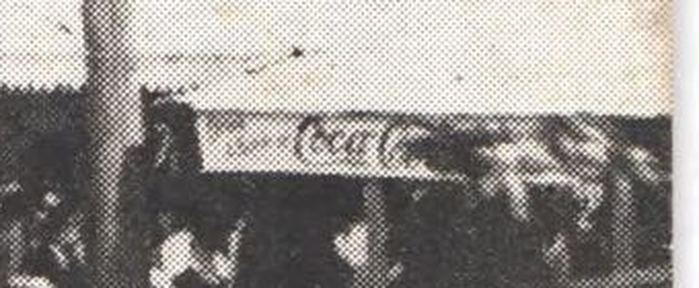
A Coca-Cola sign under a store awning in 1911
Sign detail. “East Side Public Square, Fayetteville, Tenn.,” H. G. Zimmerman & Co.; 1911 postmark. Tennessee Postcard Collection, Tennessee State Library and Archives (No Copyright – United States). Crop and marks added on a copy.

Find the white awning on the far right. Look just under its edge.

See the answer
Coca-Cola: the script is clear even through the dots. The New Georgia Encyclopedia says the first glass was sold at an Atlanta pharmacy in 1886 (the same year as our courthouse photo), that it was marketed as a “temperance drink,” and that bottling rights were sold in 1899 to two men in Chattanooga. Confidence: high.

Source: New Georgia Encyclopedia: Coca-Cola Company

Dig deeper: Fayetteville history · Which store was under that awning? Tell us

Open case

A storefront sign starts “GEO.” Can you read the rest?
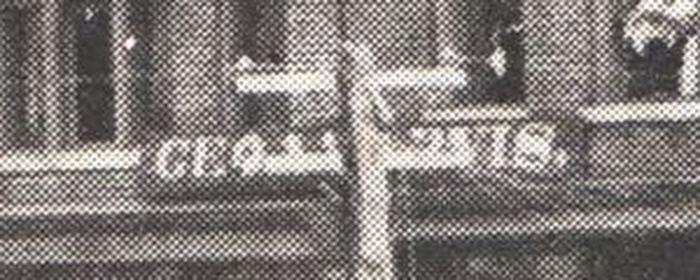
A storefront sign beginning GEO, partly hidden by a pole
Sign detail. “East Side Public Square, Fayetteville, Tenn.,” H. G. Zimmerman & Co.; 1911 postmark. Tennessee Postcard Collection, Tennessee State Library and Archives (No Copyright – United States). Crop and marks added on a copy.
What we know so far
We can read “GEO.” and only scraps of the rest; a pole and the printing dots hide the middle. Whose store it was, we don’t know. Do you?

Source: TSLA postcard record

Dig deeper: The east side storefronts · Make your case

Open case

Weekday or special day? What makes you say that?

What we know so far
A band, a car in the procession, crowds on both sidewalks and people in upstairs windows: this is a special day. The archive describes it as “what appears to be a parade.” Which parade, and which day, the card doesn’t say, and we haven’t found a newspaper report. Another postcard from the same years is titled “Stock Day in Fayetteville” (see the Stock Day case below). Was this one a stock day too? We don’t know. Do you?

Source: TSLA postcard record

Dig deeper: Do you know the occasion? Tell us · Then and now: the east side today

What does it suggest?

Stand on the courthouse lawn facing Elk Ave. What filled these storefronts then, and what’s there now?

See the answer
The 1907 and 1914 maps show the east side as dry goods, shoes and clothing (110 Elk, today City Hall), a drugstore and a bank (106 Elk, today the drugstore), hardware and queensware (104 Elk, today a law office) and the Odd Fellows hall corner (100 Elk, no business listed today). Matching each building in the postcard to its address is still an open question.

Source: Sanborn map, 1907, sheet 2 · Sanborn map, 1914, sheet 10

Dig deeper: The east side, building by building · Send us a photo from the same spot

Evidence locker: postcard: c.1911 east side parade (TSLA tpc2287) · map labels: 1907 and 1914 east side · museum source: The Met on silhouettes · encyclopedia: Coca-Cola

Send us your old photo of the square. It could become a Square Detective case. Share a photo or email hello@ourtownalmanac.com. Only send photos you own or have the owner’s OK to share. Tell us how you’d like to be credited (initials, “a reader,” or your name). Loaned photos stay yours.

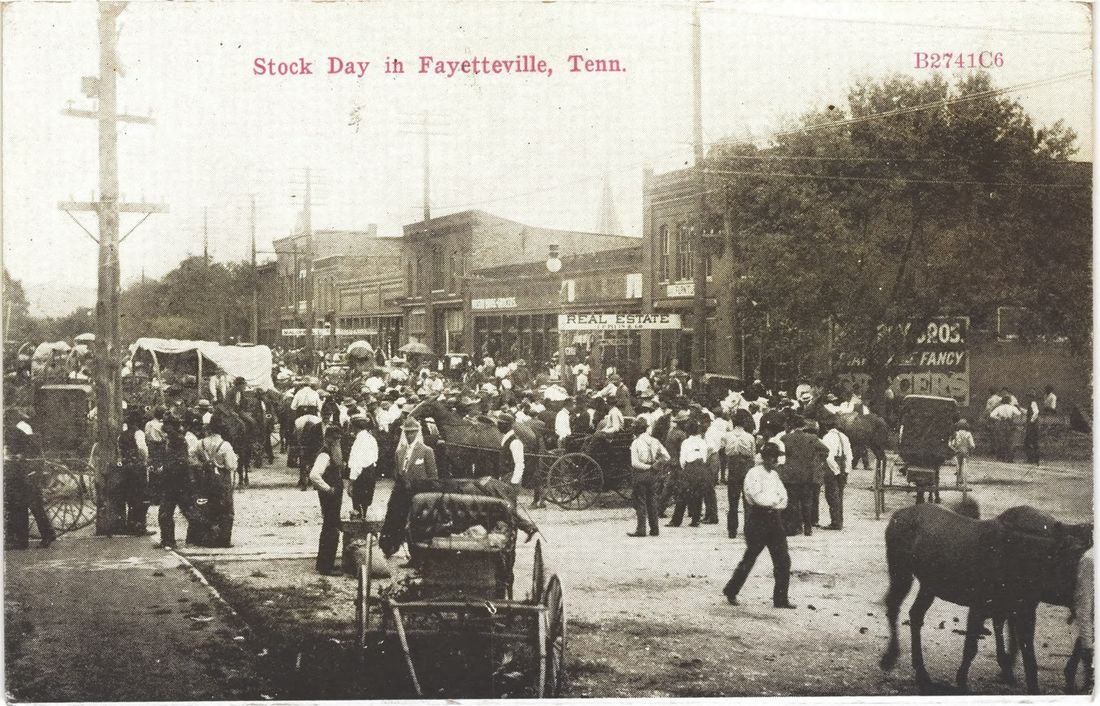
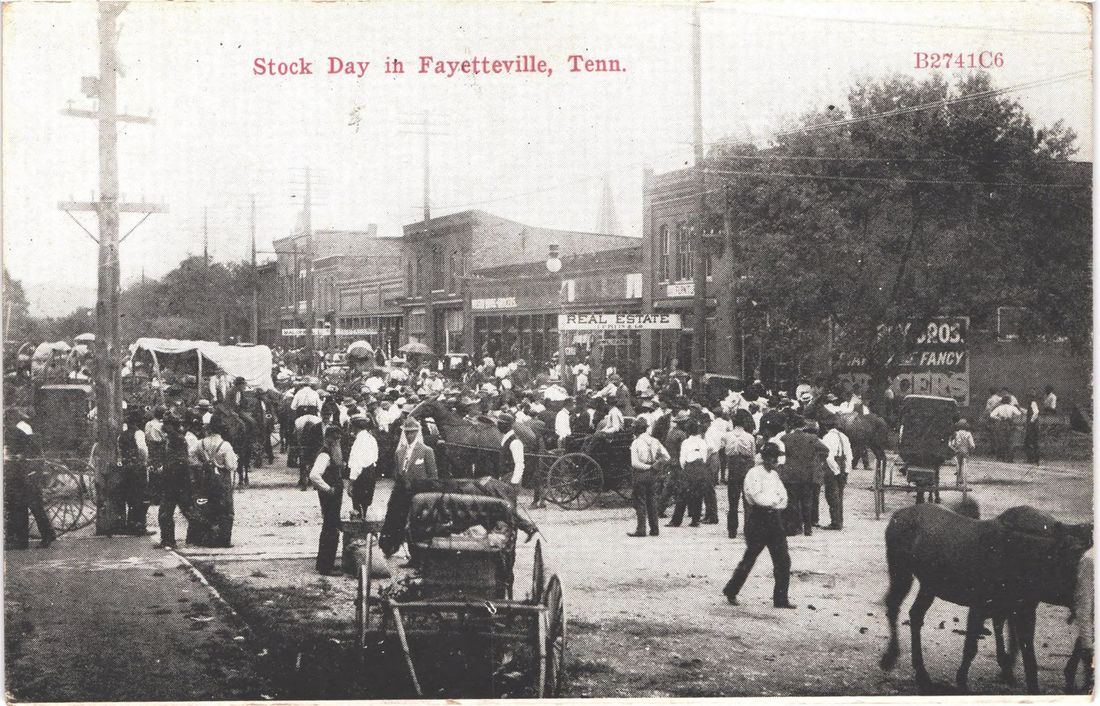
Case #5: Stock Day, 1910: where was this?

A postcard titled “Stock Day in Fayetteville.” Nobody has pinned down the spot yet.
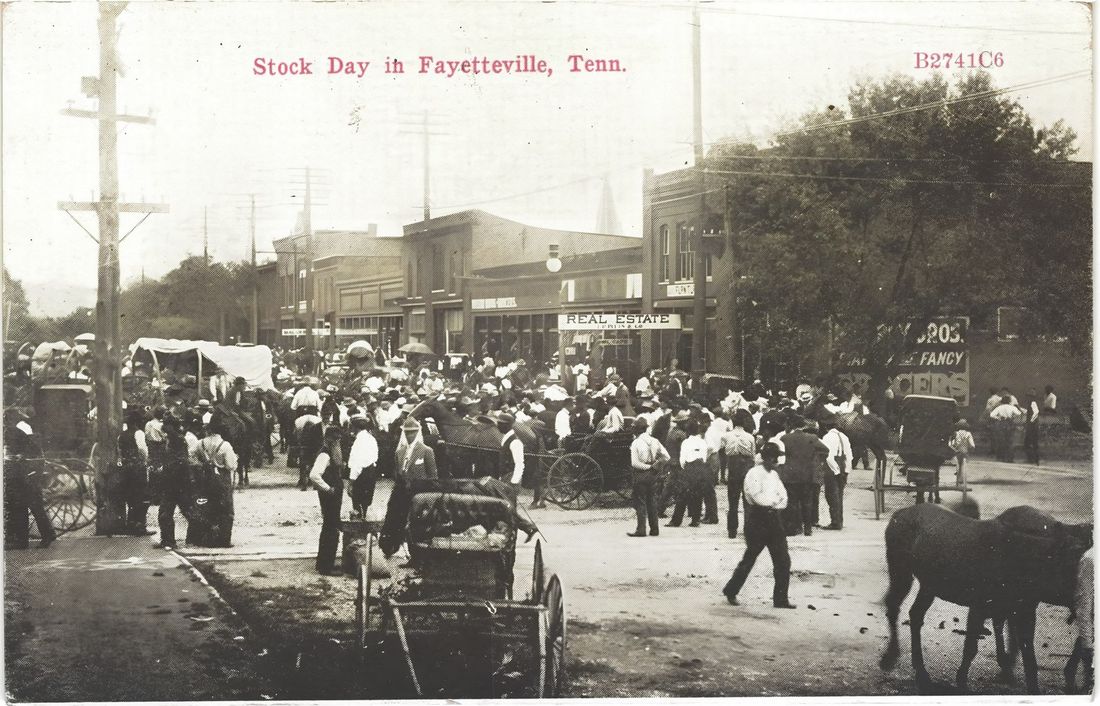
A 1910 postcard of a crowded street with horses, buggies and men in hats on Stock Day, enhanced and colorized
A 1910 postcard of a crowded street with horses, buggies and men in hats on Stock Day, colorized
A 1910 postcard of a crowded street with horses, buggies and men in hats on Stock Day, original
OriginalColorizedEnhanced & colorized
Colorized and enhanced. Drag the two handles to compare: original, colorized, enhanced & colorized. “Stock Day in Fayetteville, Tenn.,” H. G. Zimmerman & Co. postcard, postmarked Oct. 7, 1910. Tennessee Postcard Collection, Tennessee State Library & Archives (No Copyright – United States). Colorized by Our Town Almanac; colors are an educated guess. The original is unchanged. The enhanced version was enlarged 2× from the archive scan and sharpened, then colorized; faces were not retouched and nothing was drawn in. Sharpening can leave texture that isn’t in the original, so when in doubt, trust the original.

Open case

Where was this taken? We don’t know. Do you?

What we know so far
The archive says only “a street in Fayetteville.” Clues to work with: a “REAL ESTATE” sign, a sign ending in “BROS,” a row of two-story brick fronts, a big shade tree at the right and a tall pole at the left. Is this the square, or a street off it? Stand where you think the photographer stood, and tell us what you see that makes you say that.

Source: TSLA postcard record

Dig deeper: Make your case · Send us a photo from the same spot

What does it suggest?

What was “Stock Day”? Look at what’s standing in the street.

What we know so far
Horses and mules, buggies and wagons, and a crowd of men in hats: the card’s own title calls it Stock Day, a day when livestock came to town. How often it happened, and what changed hands, the card doesn’t say. Lincoln County counted 9,325 horses and mules in 1885, per Goodspeed’s county history.

Source: TSLA postcard record · Goodspeed's History of Lincoln County (1886)

Dig deeper: What did a harness shop do? · Remember stock days or mule trading? Tell us

Count it

Count the women in this crowd. What does that suggest about Stock Day?

What we know so far
Scan the whole crowd and see what you find. We’d rather hear your count than tell you ours.

Source: TSLA postcard record

Dig deeper: Compare the 1911 parade crowd · Tell us your count

Evidence locker: postcard: Stock Day, postmarked Oct. 7, 1910 (TSLA tpc1417) · county history: Goodspeed 1886

Send us your old photo of the square. It could become a Square Detective case. Share a photo or email hello@ourtownalmanac.com. Only send photos you own or have the owner’s OK to share. Tell us how you’d like to be credited (initials, “a reader,” or your name). Loaned photos stay yours.

Case #6: The square in color: look again

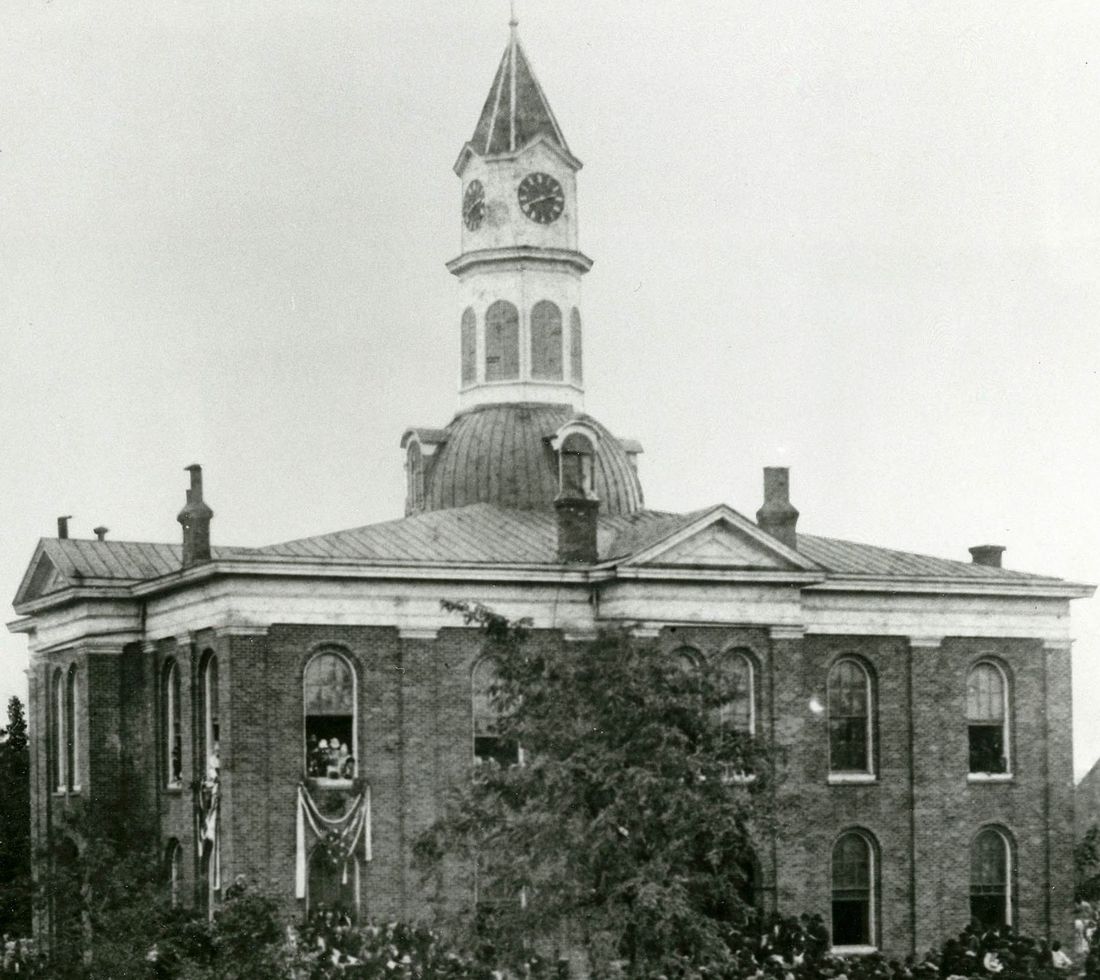
Two close-ups, colorized. Color can make you notice things you skimmed past. It can’t tell you what color anything really was.
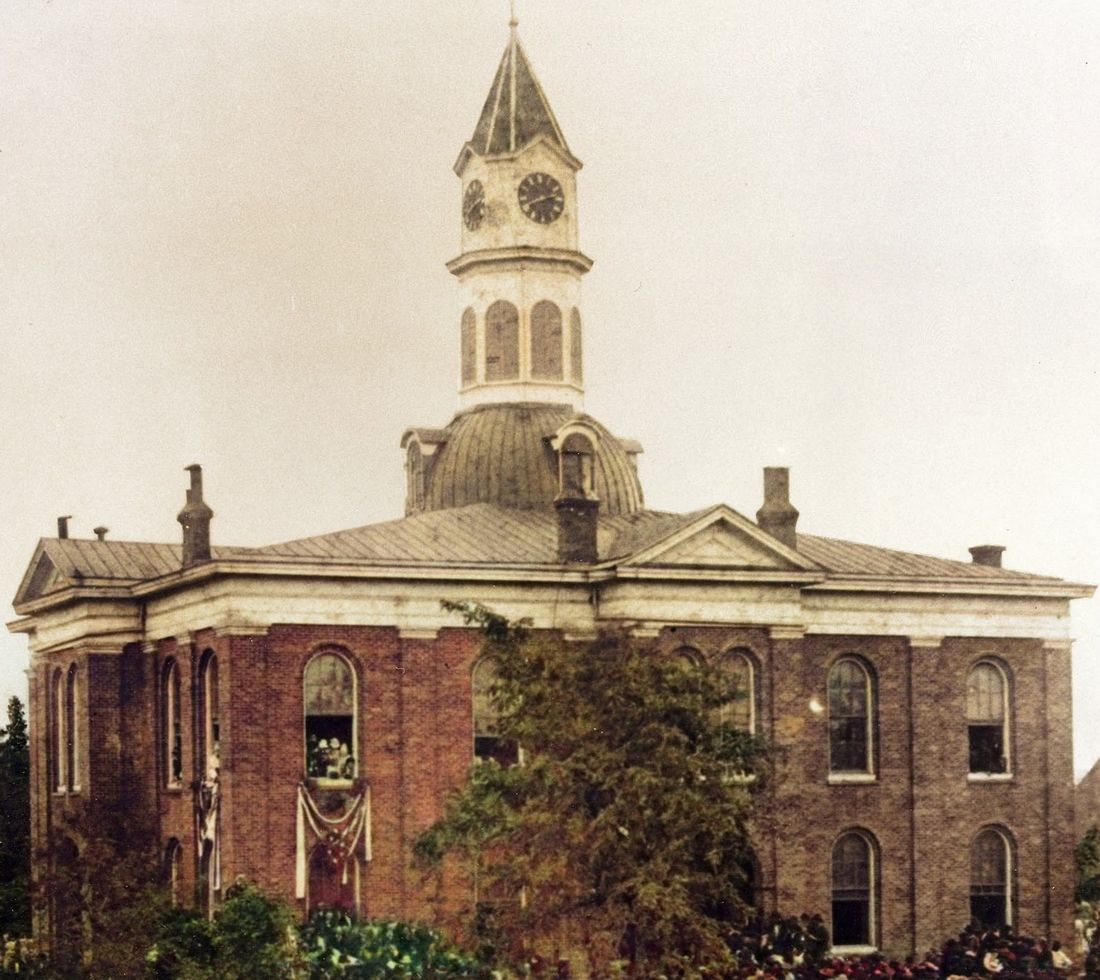
Detail of the 1886 courthouse: clock tower, dome, chimneys and upper windows, colorized
Detail of the 1886 courthouse: clock tower, dome, chimneys and upper windows, original
OriginalColorized
Colorized. Drag the round handle to compare. Detail of the 1886 photo by T. V. McCown. Courtesy Tennessee State Library & Archives. Colorized by Our Town Almanac; colors are an educated guess. The original is unchanged.

Look up

Look at the dome and the roof. See the straight lines running up them? What do you think the dome was covered with?

What we know so far
The lines are there in the original, so they aren’t from the coloring. Metal sheets with raised seams? Wood? Slate? We don’t know. Do you?

Source: TSLA photo record

Dig deeper: Make your case · How they built the old courthouse

Open case

The window trim and cornices look pale against the walls, even in the black and white. Stone, painted wood, or something else?

What we know so far
The contrast is in the original photo. What it was made of, the photo can’t tell us. We don’t know. Do you?

Source: TSLA photo record

Dig deeper: Make your case

Open case

What color was the courthouse, really? Our colorized version had to pick one.

What we know so far
The colors here are an educated guess. A black and white photo records light and dark, not hue. If a painting, a written description or a brick from the building survives, that would settle it. We don’t know. Do you?

Source: TSLA photo record

Dig deeper: Have a brick or a description? Tell us
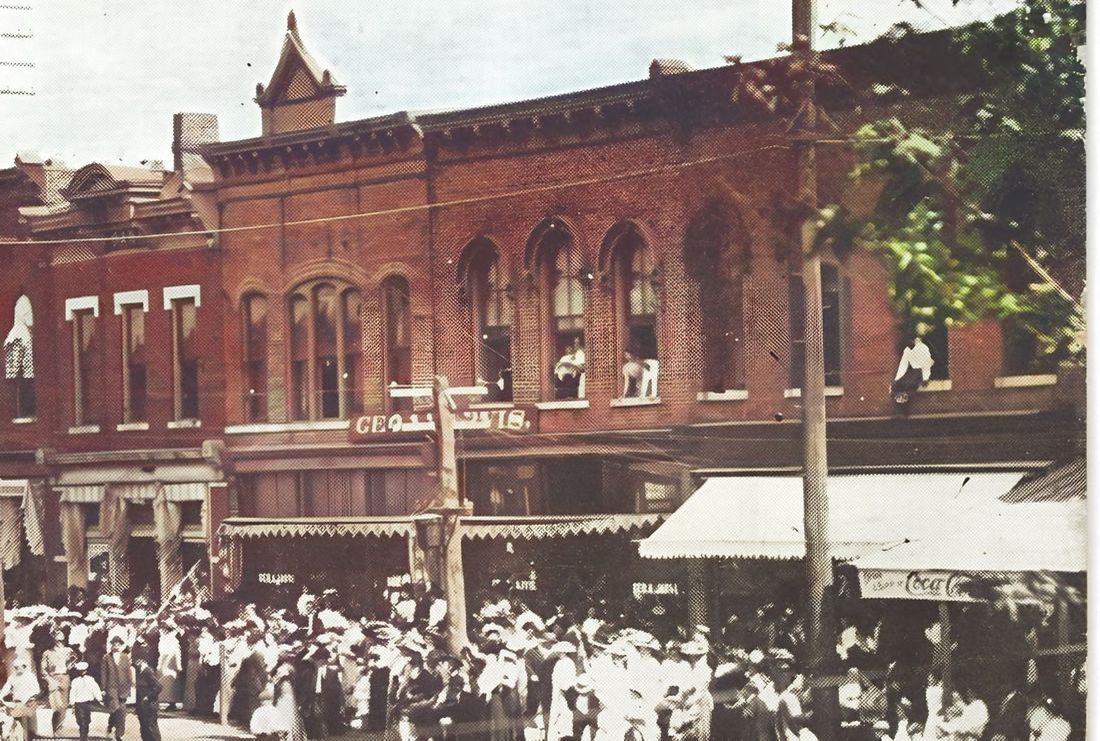
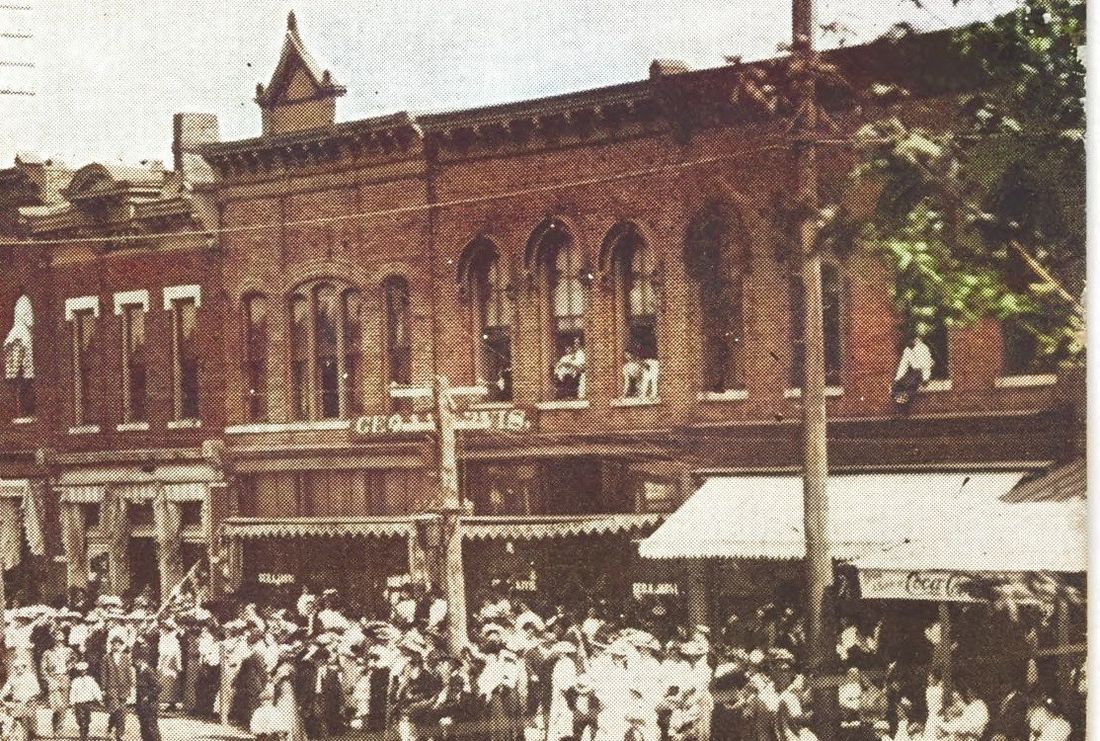
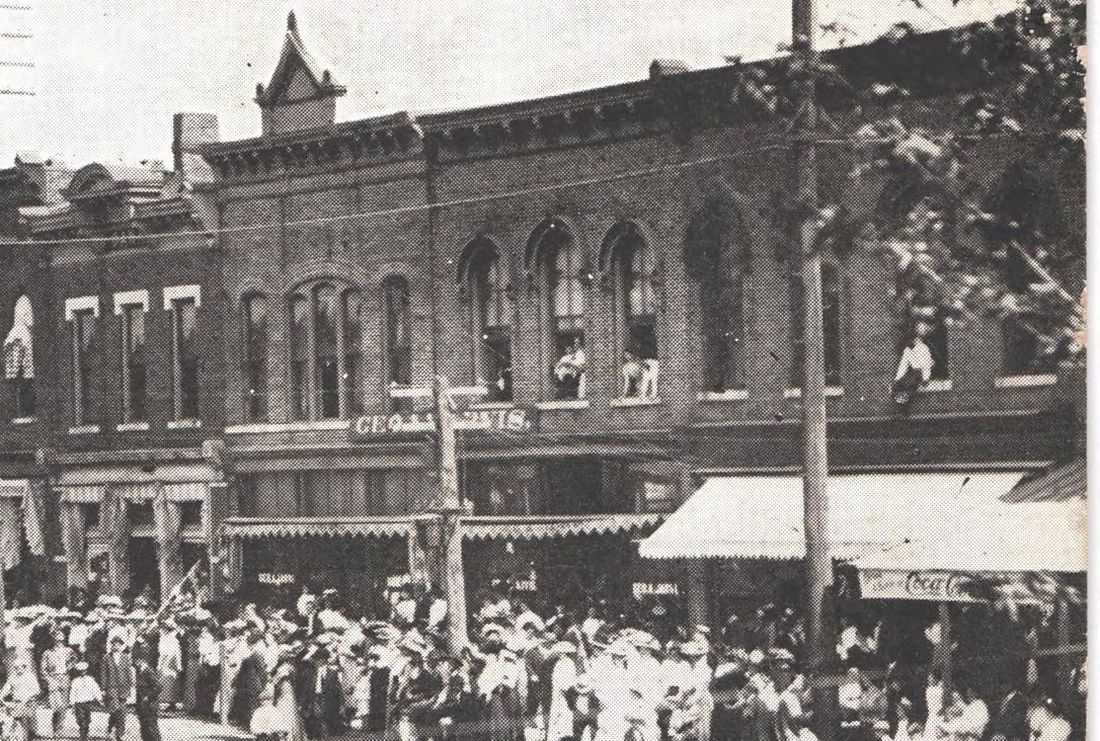
Detail of the 1911 postcard: east side storefronts with awnings, signs and people in upstairs windows, enhanced and colorized
Detail of the 1911 postcard: east side storefronts with awnings, signs and people in upstairs windows, colorized
Detail of the 1911 postcard: east side storefronts with awnings, signs and people in upstairs windows, original
OriginalColorizedEnhanced & colorized
Colorized and enhanced. Drag the two handles to compare: original, colorized, enhanced & colorized. Detail of “East Side Public Square, Fayetteville, Tenn.,” postmarked 1911. Tennessee Postcard Collection, Tennessee State Library & Archives (No Copyright – United States). Colorized by Our Town Almanac; colors are an educated guess. The original is unchanged. The enhanced version was enlarged 2× from the archive scan and sharpened, then colorized; faces were not retouched and nothing was drawn in. Sharpening can leave texture that isn’t in the original, so when in doubt, trust the original.

Look closely

Find the scalloped awnings and the plain white one. What colors do you think the stripes were?

What we know so far
The stripes show as light and dark bands in the original. The colors in our version are a guess. We don’t know. Do you?

Source: TSLA postcard record

Dig deeper: Make your case

Look up

Look at the upstairs arched windows. Who’s up there, and what are they doing?

What we know so far
People are leaning out and watching from the second floor, the best seats in the house. Who they were, and what those upstairs rooms were used for in 1911, the card doesn’t say. We don’t know. Do you?

Source: TSLA postcard record

Dig deeper: What filled these storefronts? · Tell us

Look up

Look up at the roofline, top left. There’s a small pointed peak sticking up. What do you think it was for?

What we know so far
It’s there in the original, above the cornice. Decoration, a vent, a skylight, a marker for the building’s name? The card doesn’t say. We don’t know. Do you?

Source: TSLA postcard record

Dig deeper: Is it still there? Go look and tell us · The east side, building by building

Evidence locker: photo: 1886 courthouse (TSLA) · postcard: c.1911 east side (TSLA tpc2287)

Send us your old photo of the square. It could become a Square Detective case. Share a photo or email hello@ourtownalmanac.com. Only send photos you own or have the owner’s OK to share. Tell us how you’d like to be credited (initials, “a reader,” or your name). Loaned photos stay yours.

Case #7: The 1914 map labels

The fire-insurance mapmakers wrote down what every storefront did. Some labels are puzzles of their own.

Find the clue

Which building was a pool hall in 1914? Find it on the map.
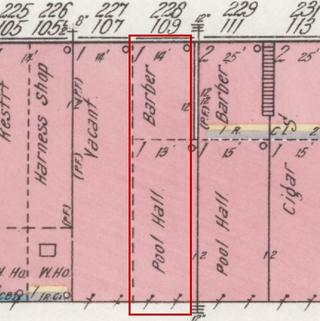
1914 map detail of 111 Market St. E. outlined in red
1914 map. Sanborn Map Co., Fayetteville, April 1914, sheet 9, Library of Congress (public domain). Cropped; red outline added by Our Town Almanac.
See the answer
Two neighboring storefronts on the south side are labeled “Barber / Pool Hall” (1914 numbers 109 and 111). Today they are 111 Market St. E., home of Señor Lopez Mexican Grill, and the lot at 113 Market St. E., where no building stands now. Sanborn abbreviation lists use “Bill’ds” for billiards, too.

Source: Sanborn map, April 1914, sheet 9 · MIT: Abbreviations for Sanborn maps

Dig deeper: 111 Market St. E., building by building · What was upstairs here in 1887?

Find the clue

Find the harness shop. Where was it, and what’s there now?
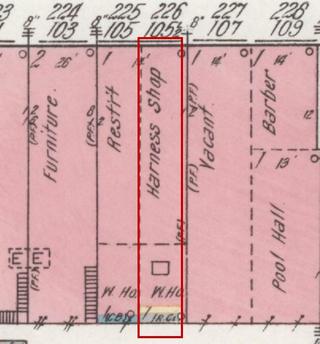
1914 map detail of 107 Market St. E. labeled Harness Shop
1914 map. Sanborn Map Co., Fayetteville, April 1914, sheet 9, Library of Congress (public domain). Cropped; red outline added by Our Town Almanac.
See the answer
In 1914: “Harness Shop” at 107 Market St. E. (1914 number 105½), today Southside Barbershop. Earlier, the 1887 map lists “Harness; Hardw.” at 103 Main Ave. S. (today a public office), and in 1897 a grocery and harness shop shared 113 Market St. E.

Source: Sanborn map, April 1914, sheet 9 · Sanborn map, 1887, sheet 1

Dig deeper: Why did harness shops vanish? · 107 Market St. E.

What we still can’t tell

What did a harness shop do, and why did they vanish?

What we know so far
Harness is the gear of straps and collars that hitches a horse or mule to a wagon, buggy or plow, and harness makers made and mended it; Goodspeed’s 1886 history lists “saddlers and harness-makers” in the county. Lincoln County counted 9,325 horses and mules in 1885. The square’s maps show harness, wagons, buggies, carriages and feed from 1887 to 1914. When the last one closed, the maps can’t say: by 1926 most labels read only “S.” Did cars do it? That’s the likely suspect, but we don’t have local proof yet.

Source: Goodspeed's History of Lincoln County (1886) · Sanborn map, April 1914, sheet 9

Dig deeper: The square through the decades · Remember a harness or saddle shop? Tell us

What does it suggest?

In 1914, one shop on the square was marked “electric motor.” What did it mean?
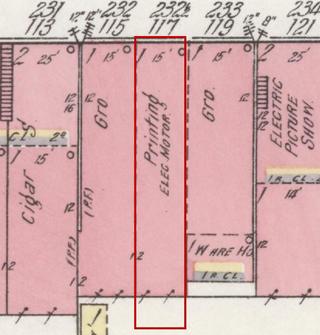
1914 map detail of 121 Market St. E., the print shop
1914 map. Sanborn Map Co., Fayetteville, April 1914, sheet 9, Library of Congress (public domain). Cropped; red outline added by Our Town Almanac.
See the answer
It was the print shop at 121 Market St. E. (1914 number 117), labeled “Printing (electric motor).” The most likely reading: an electric motor ran the press. Why write it down? The Library of Congress says these maps were made to help fire insurers judge each building’s hazard, and that use labels mattered because they had “some bearing on the likelihood of fires.” The same 1914 map notes the courthouse’s “Heat: stove. Lights: electric.” We haven’t found the map key’s own wording for motors, so “ran the press” is our best reading, not a quote. Today no building stands on that lot. Confidence: high for the label; moderate that it powered the press.

Source: Sanborn map, April 1914, sheet 9 · Library of Congress: Interpreting Sanborn maps · Library of Congress: Sanborn maps resource guide

Dig deeper: Why did a drugstore keep oil in its cellar? · 121 Market St. E.

What does it suggest?

In 1907 you couldn’t dial a phone. How did your call get through?
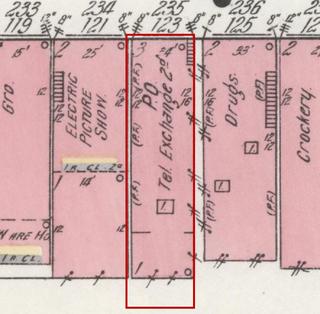
1914 map detail of 127 Market St. E.
127 Market St. E. on the 1914 map (the post office). Sanborn Map Co., Fayetteville, April 1914, sheet 9, Library of Congress (public domain). Cropped; red outline added by Our Town Almanac.
See the answer
Through the “Telephone Exch.” upstairs at 127 Market St. E. (the 1907 map: “Post Office; Telephone Exch. 2d”; today The Skin Refinery). At a manual exchange an operator answered, you asked for a name or number, and she plugged a cord into the right socket on the switchboard. Operators were mostly young women, and their scripted greeting was “Number, please.” Which company ran Fayetteville’s exchange, and when dial phones arrived here, we haven’t confirmed.

Source: Sanborn map, 1907, sheet 2 · PBS American Experience: The Telephone

Dig deeper: Where was the telegraph office in 1887? · When did Fayetteville get dial phones? Tell us

Find the clue

Crockery and queensware: what were they selling?
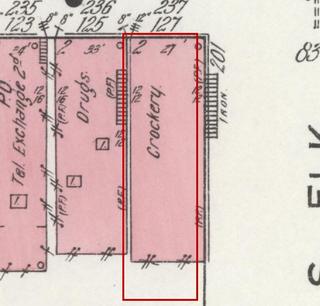
1914 map detail of 131 Market St. E.
131 Market St. E. on the 1914 map. Sanborn Map Co., Fayetteville, April 1914, sheet 9, Library of Congress (public domain). Cropped; red outline added by Our Town Almanac.
See the answer
Dishes. Crockery is earthenware (Merriam-Webster). Queen’s ware was Josiah Wedgwood’s cream-colored earthenware, named for Queen Charlotte in the 1760s (V&A). On the square: “Hardware & Queensware” at 104 Elk Ave. S. in 1907 (today a law office), and “Crockery” in 1914 at 131 Market St. E. (today a boutique and a law office) and at 100 Elk Ave. S. (no business listed today). Whether anyone here sold real Wedgwood, the maps don’t say.

Source: Merriam-Webster: crockery · V&A: Wedgwood, an introduction · Sanborn map, April 1914, sheet 9

Dig deeper: 104 Elk Ave. S. · 131 Market St. E.

What does it suggest?

What was an “Electric Picture Show”?
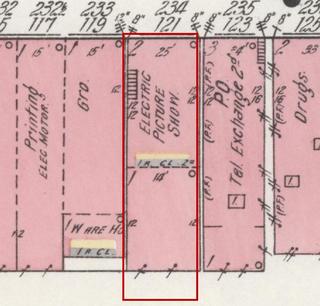
1914 map detail of 125 Market St. E., the Electric Picture Show
1914 map. Sanborn Map Co., Fayetteville, April 1914, sheet 9, Library of Congress (public domain). Cropped; red outline added by Our Town Almanac.
See the answer
A movie house, at 125 Market St. E. In 1914 the map calls it the “Electric Picture Show”; in 1926 the same building is labeled “Movies.” In 1891 it had been an undertaker’s and furniture repair shop. Films were silent, and the Library of Congress says silent films “were always accompanied by at least one instrument,” from a piano or organ up to an orchestra. Why this one called itself “Electric,” we haven’t found.

Source: Sanborn map, April 1914, sheet 9 · Library of Congress: A Warming Flame (silent film music)

Dig deeper: It’s 1926. What’s playing? · 125 Market St. E.

Evidence locker: map labels: Sanborn 1914 sheet 9; 1907 sheet 2; 1887 sheet 1 · research guide: Library of Congress on Sanborn maps · dictionary and museum: crockery, Queen’s ware

Send us your old photo of the square. It could become a Square Detective case. Share a photo or email hello@ourtownalmanac.com. Only send photos you own or have the owner’s OK to share. Tell us how you’d like to be credited (initials, “a reader,” or your name). Loaned photos stay yours.

Case #8: Movie night, 1926

The map says “Movies.” The rest is up to you.

Open case

It’s 1926 and you have pocket money. What’s playing on the square?

What we know so far
The 1926 map shows one movie house on the square: “Movies” at 125 Market St. E., the old Electric Picture Show. (The Lincoln Theatre didn’t open until 1951.) What it showed, we can’t say yet: the 1926 local papers aren’t freely digitized. Nationally, 1926 brought Douglas Fairbanks’ The Black Pirate, filmed in early two-color Technicolor, Rudolph Valentino’s The Son of the Sheik, and Don Juan, which premiered Aug. 6, 1926 with a recorded score and sound effects but no talking. Talking pictures arrived with The Jazz Singer on Oct. 6, 1927, and even it had only about two minutes of dialogue. Ticket prices here: unknown.

Source: Sanborn map, 1926, sheet 5 (UT Knoxville Libraries) · Cinema Treasures: Lincoln Theatre · Library of Congress: The Jazz Singer essay · Wikipedia: 1926 in film (national titles)

Dig deeper: Have a 1920s movie ad or ticket stub? Send it · What was the Electric Picture Show?

Evidence locker: map label: 1926 “Movies” (UT Knoxville) · national film history: Library of Congress

Send us your old photo of the square. It could become a Square Detective case. Share a photo or email hello@ourtownalmanac.com. Only send photos you own or have the owner’s OK to share. Tell us how you’d like to be credited (initials, “a reader,” or your name). Loaned photos stay yours.

Case #9: From the old paper: the courthouse well, 1876–1878

Two years, two holes (maybe), one pump. Read each clip, decide what you’d do, then see what happened.

Eight short items from the Fayetteville Observer, in the order they ran. At each one, stop and decide what you’d do next. Then open it to see what the county did.

Clip 1 of 8

July 1876. The county wants a well in the courthouse yard. You’re on the Well Committee. How do you pay the diggers: by the day, by the job, or by the foot? What would you do next?
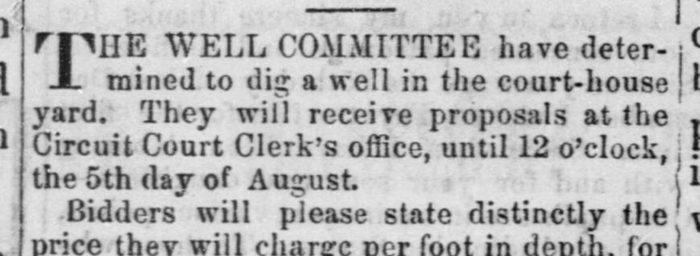
1876 newspaper notice: the Well Committee will take bids to dig a well in the courthouse yard, priced per foot of depth
Fayetteville Observer, July 27, 1876, p. 3. Library of Congress, Chronicling America (public domain). Cropped.
See the answer
By the foot. The committee took sealed proposals at the Circuit Court Clerk’s office until noon on Aug. 5, and asked bidders to state “the price they will charge per foot in depth.” Next: four weeks later, the diggers hit rock.

Still open: Who won the bid, and at what price per foot? We haven’t found it. Do you know?

Source: Fayetteville Observer, July 27, 1876, p. 3

Dig deeper: Clip 2: 25 feet down

Clip 2 of 8

August 1876. About 25 feet down, “the diggers are now in solid rock.” Paid by the foot, in rock. Keep going or quit? What would you do next?
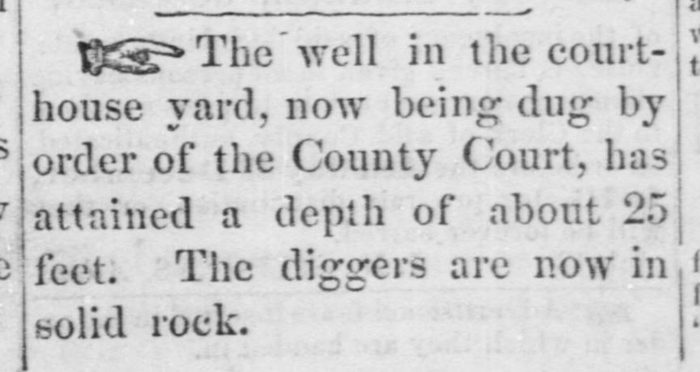
1876 newspaper item: the courthouse well is about 25 feet deep and the diggers are in solid rock
Fayetteville Observer, Aug. 24, 1876, p. 3. Library of Congress, Chronicling America (public domain). Cropped.
See the answer
They kept going. The next item we’ve found is more than a year later, and by then the hole is 130 feet deep.

Still open: How did they cut through rock in 1876: picks, drills, blasting powder? The paper doesn’t say. We don’t know. Do you?

Source: Fayetteville Observer, Aug. 24, 1876, p. 3

Dig deeper: Clip 3: 130 feet

Clip 3 of 8

November 1877. 130 feet. No water. The borers have quit. What would you do next?
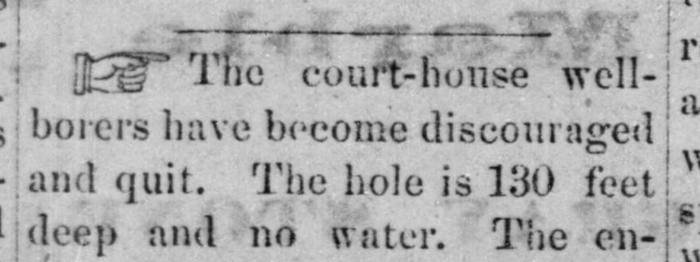
1877 newspaper item: the courthouse well-borers quit; the hole is 130 feet deep with no water
Fayetteville Observer, Nov. 22, 1877, p. 3. Library of Congress, Chronicling America (public domain). Cropped.
See the answer
Bring in a machine. Eleven weeks later, an engine and a well-boring machine were back at the courthouse.

Still open: What happened in the 15 months between clip 2 and clip 3? We haven’t found it.

Source: Fayetteville Observer, Nov. 22, 1877, p. 3

Dig deeper: Clip 4: the machine comes back

Clip 4 of 8

February 1878. “The engine and well-boring machine are again at the court-house, at work near the south-east corner of the building, for water.” Would you bet on water this time? What would you do next?
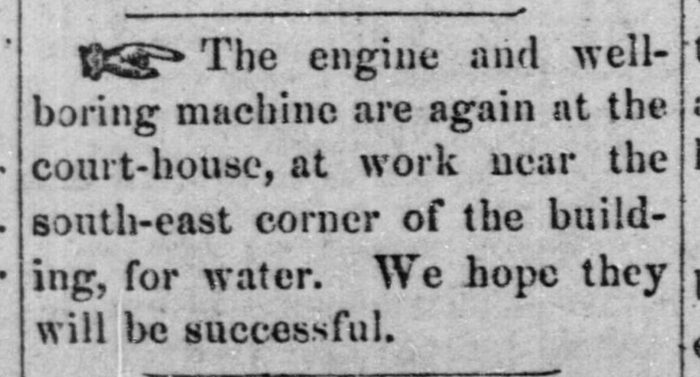
1878 newspaper item: the engine and well-boring machine are back at the courthouse near the southeast corner
Fayetteville Observer, Feb. 7, 1878, p. 3. Library of Congress, Chronicling America (public domain). Cropped.
See the answer
Four weeks later, a sign went up on a post at the courthouse to tell everyone how deep it was, and what they’d found.

Still open: Same hole, or a new one? The paper doesn’t say.

Source: Fayetteville Observer, Feb. 7, 1878, p. 3

Dig deeper: Clip 5: the placard · Go look: the southeast corner today

Clip 5 of 8

March 1878. The placard says the well is “81 feet deep, 63 feet through solid rock and 30 feet of sulphur and salt water.” Do the numbers add up?
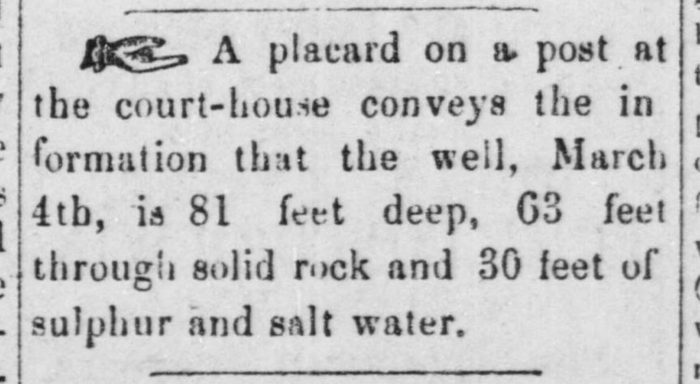
1878 newspaper item: a placard at the courthouse says the well is 81 feet deep with 30 feet of sulphur and salt water
Fayetteville Observer, Mar. 7, 1878, p. 3. Library of Congress, Chronicling America (public domain). Cropped.
Our best guess
63 plus 30 is 93, and the well is 81 feet deep. One way to make it work: the 30 feet of water could be standing in the bottom of the hole, overlapping the rock. That’s our guess, not the paper’s. And 81 feet is shallower than the 130 reported in November, which hints at a new boring, but again, the paper doesn’t say.

Still open: How do 81, 63 and 30 fit together? We don’t know. Do you?

Source: Fayetteville Observer, Mar. 7, 1878, p. 3

Dig deeper: Clip 6: the bucket test · Make your case

Clip 6 of 8

Same week. Someone boiled down a bucket of the well water. Why would you do that, and what do you think was left? What would you do next?
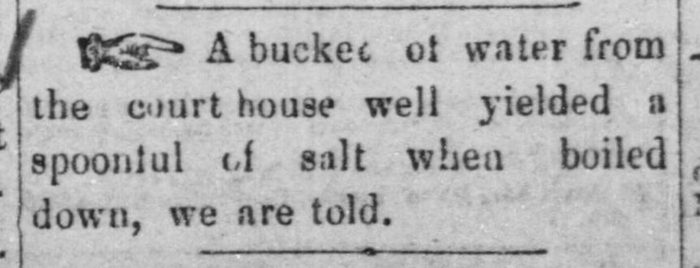
1878 newspaper item: a bucket of water from the courthouse well yielded a spoonful of salt when boiled down
Fayetteville Observer, Mar. 7, 1878, p. 3. Library of Congress, Chronicling America (public domain). Cropped.
See the answer
“A spoonful of salt,” the paper said, adding “we are told.” Next: they put in a pump anyway.

Source: Fayetteville Observer, Mar. 7, 1878, p. 3

Dig deeper: Clip 7: the pump goes in

Clip 7 of 8

April 1878. The pump is in. Salty, sulphur water from under the courthouse. Would you drink it? What did people say it did?
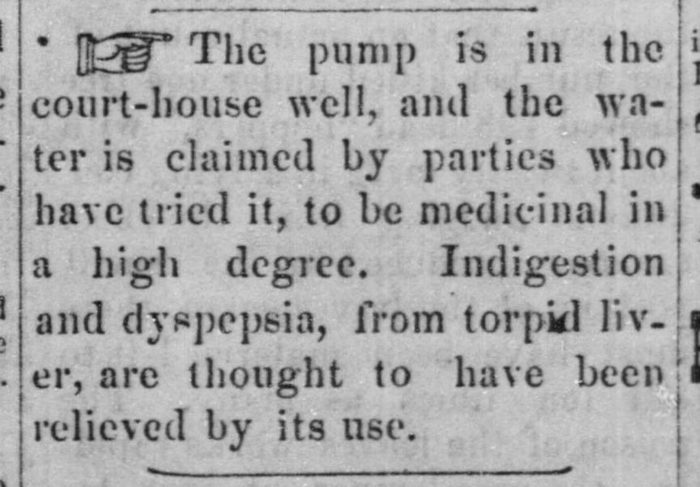
1878 newspaper item: the pump is in the courthouse well and the water is claimed to be medicinal
Fayetteville Observer, Apr. 18, 1878, p. 3. Library of Congress, Chronicling America (public domain). Cropped.
See the answer
Some did, and the paper reported that the water “is claimed by parties who have tried it, to be medicinal in a high degree. Indigestion and dyspepsia, from torpid liver, are thought to have been relieved by its use.” Note the hedges: “claimed,” “thought to have been.” Next: one week later.

Source: Fayetteville Observer, Apr. 18, 1878, p. 3

Dig deeper: Clip 8: one week later

Clip 8 of 8

One week later, the whole item is one short sentence. What do you think happened next?
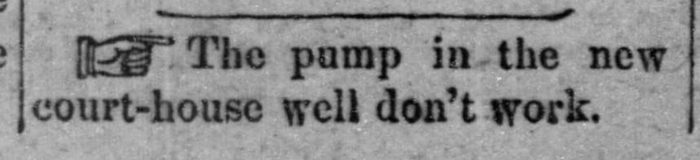
1878 newspaper item: the pump in the new courthouse well does not work
Fayetteville Observer, Apr. 25, 1878, p. 3. Library of Congress, Chronicling America (public domain). Cropped.
What we know so far
“The pump in the new court-house well don’t work.” After that, we haven’t found another word about it. Was it fixed, capped, or filled in? We don’t know. Do you?

Still open: Is the shaft still under the lawn? We don’t know.

Source: Fayetteville Observer, Apr. 25, 1878, p. 3

Dig deeper: Go look: the southeast corner of the lawn today · Know what became of it? Tell us

Evidence locker: newspaper clippings: Fayetteville Observer, July 1876 to April 1878, Library of Congress (public domain)

Send us your old photo of the square. It could become a Square Detective case. Share a photo or email hello@ourtownalmanac.com. Only send photos you own or have the owner’s OK to share. Tell us how you’d like to be credited (initials, “a reader,” or your name). Loaned photos stay yours.

Case #10: From the old paper: more case files

Short items from the Fayetteville Observer, 1866–1880. Read the clipping, then guess before you open the answer.

Question

In the 1870s the county dug a well in the courthouse yard. What came up instead of water?

1877 newspaper item: the courthouse well-borers quit; the hole is 130 feet deep with no water
Fayetteville Observer, Nov. 22, 1877, p. 3. Library of Congress, Chronicling America (public domain). Cropped.

Read the clipping. How deep did they go?

See the answer
Salt and sulphur. Diggers hit solid rock at about 25 feet; by November 1877 the hole was 130 feet deep with “no water,” and the borers quit. A boring engine came back near the southeast corner of the building, and in March 1878 the paper reported that a bucket of the well water “yielded a spoonful of salt when boiled down.” Some called it “medicinal.” A week after the pump went in: “The pump in the new court-house well don’t work.” Is the shaft still under the lawn? Nobody knows.

Source: Fayetteville Observer, Nov. 22, 1877, p. 3 · Fayetteville Observer, Mar. 7, 1878, p. 3 · Fayetteville Observer, Apr. 25, 1878, p. 3

Dig deeper: The whole story, clip by clip: the well saga · Go look: the southeast corner of the courthouse lawn

Question

Why would a town set a pile of barrels on fire on purpose in 1877?
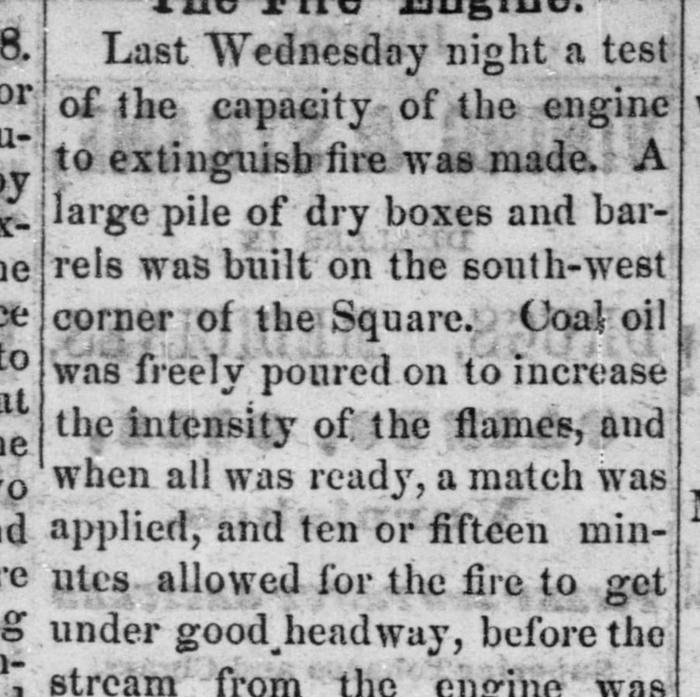
1877 newspaper story about the fire engine test on the square
Fayetteville Observer, July 5, 1877, p. 3. Library of Congress, Chronicling America (public domain). Cropped.

Find the words “coal oil.” What were they trying to prove?

See the answer
To test its new fire engine. “A large pile of dry boxes and barrels” was built on the southwest corner of the square and soaked with coal oil. It was allowed to burn ten or fifteen minutes before the stream from the engine was turned on. The flames were “readily suppressed.” The editor’s verdict: it worked, but “the engine cost too much.”

Still open: Where did the town keep its engine, and who ran it? The clipping doesn’t say. We don’t know. Do you?

Source: Fayetteville Observer, July 5, 1877, p. 3

Dig deeper: Same corner, 1866: lightning down the drainpipes · The square’s history

Question

One Sunday night in 1866, something came down the drainpipes on the southwest corner and threw bricks out of the pavement. What was it?
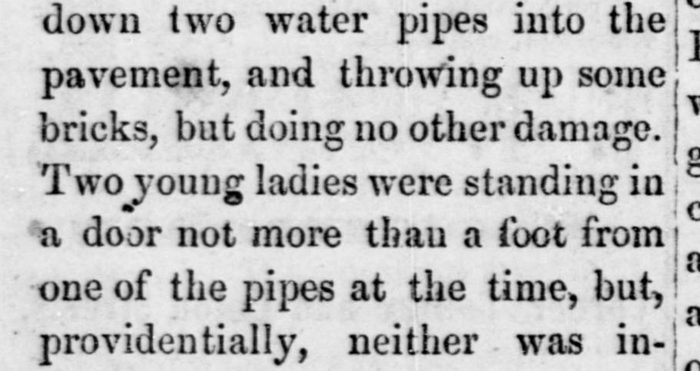
1866 newspaper item: lightning ran down two water pipes into the pavement and threw up bricks; two young ladies nearby were not injured
Fayetteville Observer, July 12, 1866, p. 3. Library of Congress, Chronicling America (public domain). Cropped.
See the answer
Lightning. It struck the building on the southwest corner, ran down two water pipes into the brick pavement and threw up bricks. Two young women were standing in a doorway about a foot from one of the pipes, “but, providentially, neither was injured.”

Source: Fayetteville Observer, July 12, 1866, p. 3

Dig deeper: Go look: the downspouts at 101 Market St. E.

Question

In 1871 the courthouse yard held “eight flying horses.” What were they?
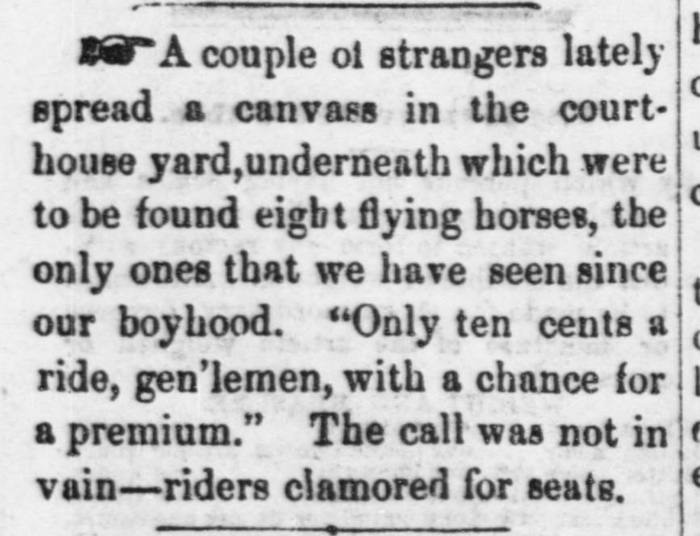
1871 newspaper item about eight flying horses in the courthouse yard
Fayetteville Observer, Sept. 7, 1871, p. 3. Library of Congress, Chronicling America (public domain). Cropped.
See the answer
A carousel. Two traveling strangers put up a canvas tent in the courthouse yard with eight “flying horses” inside, the first the editor had seen since boyhood: “Only ten cents a ride, gen’lemen, with a chance for a premium.” Riders “clamored for seats.”

Still open: What made the horses go round: a crank, a horse, a man pushing? The paper doesn’t say. We don’t know. Do you?

Source: Fayetteville Observer, Sept. 7, 1871, p. 3

Dig deeper: What else has the courthouse lawn held?

Question

In 1876 a couple walked to Fayetteville from beyond Decherd. Why, and how did the town greet them?

See the answer
They came to be married at the courthouse. The paper said it “was equal to a circus for fun.” Young men in town lent them their best clothes and gave them a buggy parade around the square, and so many people followed them in that the courtroom filled. The couple stood up on the judge’s stand so everyone could see, sat for a portrait at a local photo gallery, and then “left town afoot, hand in hand, homeward bound.”

Source: Fayetteville Observer, Oct. 5, 1876, p. 3

Dig deeper: Where was a photographer on the square in 1887?

Question

In 1870, court quit “without the formality of an adjournment.” What sent everyone running?
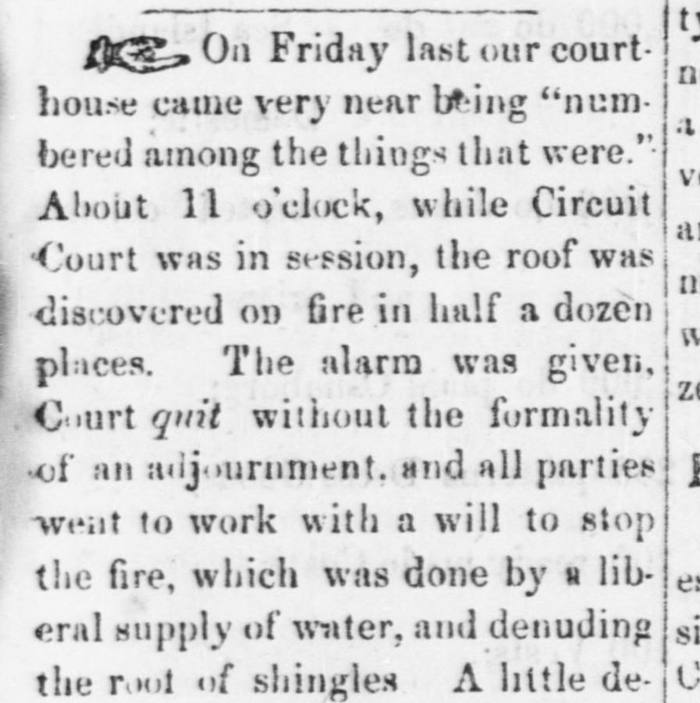
1870 newspaper story about the courthouse roof fire
Fayetteville Observer, Nov. 24, 1870, p. 3. Library of Congress, Chronicling America (public domain). Cropped.
See the answer
The courthouse roof was on fire “in half a dozen places,” from an overheated stove-pipe, while Circuit Court was in session. The fire was put out, and the old brick courthouse survived three more years.

Source: Fayetteville Observer, Nov. 24, 1870, p. 3

Dig deeper: Count the chimneys on the next courthouse

Question

The clock tower on the old courthouse: was it there from the start, or an argument first?

See the answer
An argument first. In August 1873 the paper said a clock in the new courthouse’s cupola “has been a prominent subject,” with a quote of $1,200 for a good clock and a large new bell.

Source: Fayetteville Observer, Aug. 21, 1873, p. 3

Dig deeper: What time does that clock say in 1886?

Question

In June 1873, two wooden buildings by the northeast corner disappeared in under 24 hours. What happened?
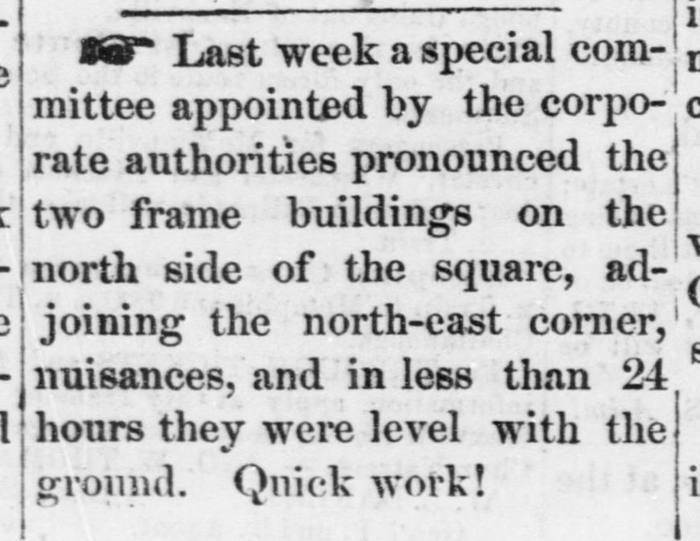
1873 newspaper item about two buildings razed on the north side
Fayetteville Observer, June 19, 1873, p. 3. Library of Congress, Chronicling America (public domain). Cropped.
See the answer
The town’s committee declared them nuisances, and “in less than 24 hours they were level with the ground. Quick work!” Which lots they stood on, the paper doesn’t say.

Source: Fayetteville Observer, June 19, 1873, p. 3

Dig deeper: The northeast corner today · Make your case: which lot?

Question

Before anyone argued about parking on the square, what did they argue about?

See the answer
Weight. In 1869 platform scales that could weigh 10,000 pounds went in on the square, because buyers and sellers guessing weights led to “hard feelings and estrangement.” In 1870 a single 10-foot poplar log on the town scales weighed 6,700 pounds.

Source: Fayetteville Observer, Apr. 29, 1869, p. 3 · Fayetteville Observer, Nov. 10, 1870, p. 3

Dig deeper: 39 wheat wagons waited on the square in 1876

Question

Count the wagons. How many wheat wagons waited on the square one July day in 1876?
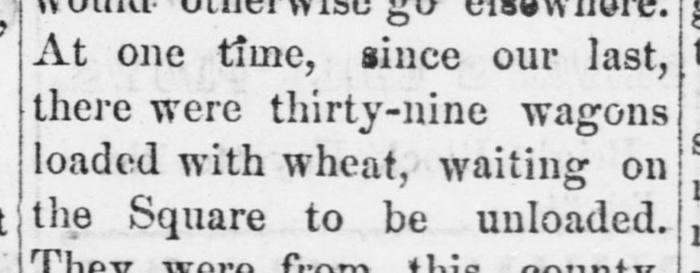
1876 newspaper item about wheat wagons on the square
Fayetteville Observer, July 13, 1876, p. 3. Library of Congress, Chronicling America (public domain). Cropped.
See the answer
Thirty-nine, waiting to unload. The square was a farm market long before it was a shopping street.

Source: Fayetteville Observer, July 13, 1876, p. 3

Dig deeper: The square through the decades

Question

In 1870, what made one back room on the northeast corner the most secure spot in the county?
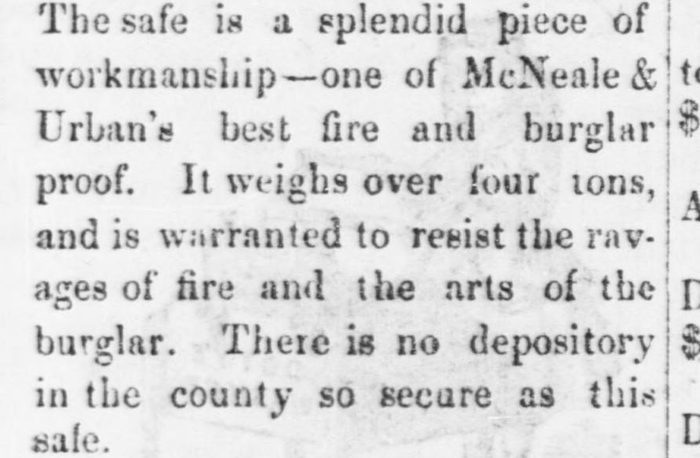
1870 newspaper item: the new safe weighs over four tons and is warranted to resist fire and burglars
Fayetteville Observer, Dec. 8, 1870, p. 3. Library of Congress, Chronicling America (public domain). Cropped.
See the answer
A safe weighing “over four tons,” installed for a new savings bank in the back room of a store on the northeast corner, and “warranted to resist the ravages of fire and the arts of the burglar.” Which of today’s buildings it stood in, we don’t know. Do you?

Source: Fayetteville Observer, Dec. 8, 1870, p. 3

Dig deeper: The north side, building by building

Question

June 1880. One Saturday evening a crowd gathered on the square. What were they looking at?
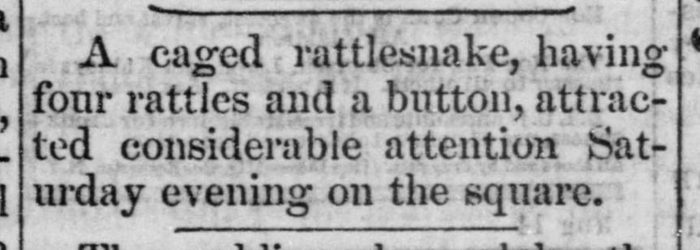
1880 newspaper item: a caged rattlesnake with four rattles and a button drew a crowd on the square
Fayetteville Observer, June 10, 1880, p. 3. Library of Congress, Chronicling America (public domain). Cropped.

Count the rattles in the clipping.

See the answer
A rattlesnake, in a cage. “A caged rattlesnake, having four rattles and a button, attracted considerable attention Saturday evening on the square.” That’s the whole item.

Still open: Who brought it, why, and where on the square did the cage sit? The paper doesn’t say. We don’t know. Do you?

Source: Fayetteville Observer, June 10, 1880, p. 3

Dig deeper: Know snakes? What’s a “button”? Tell us · More crowds on the square: 1911

Question

May 1866. The paper called something at the courthouse “one of the filthiest places that can well be imagined.” What was it?
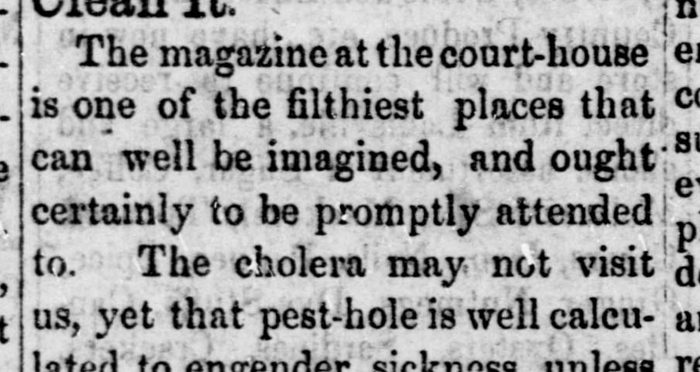
1866 newspaper item calling the magazine at the courthouse one of the filthiest places imaginable
Fayetteville Observer, May 3, 1866, p. 3. Library of Congress, Chronicling America (public domain). Cropped.
See the answer
The “magazine,” a leftover from the war. With cholera in the news, the paper warned that “that pest-hole is well calculated to engender sickness.” A week later the County Court named a committee to contract “for the removal and leveling of the bomb proof” at the court-house, with the pay to be set at the July term.

Still open: Where on the lawn did it stand, and what did it look like? No picture has turned up. We don’t know. Do you?

Source: Fayetteville Observer, May 3, 1866, p. 3 · Fayetteville Observer, May 10, 1866, p. 3

Dig deeper: What else has the courthouse lawn held?

Question

February 1879. A runaway team, two wrecked wagons, and a horse that hit a lamp-post. Which corner of the square?
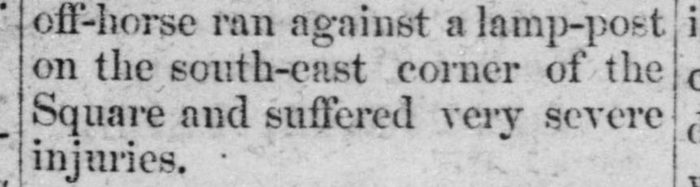
1879 newspaper item: a runaway horse ran against a lamp-post on the southeast corner of the square
Fayetteville Observer, Feb. 27, 1879, p. 3. Library of Congress, Chronicling America (public domain). Cropped.
See the answer
The southeast corner. A team pulling a wagon load of hay ran away; the driver fell off and a wheel ran over his ankle, breaking it. In front of the Observer office the team hit a wagon loaded with wood, “completely wrecking the one they were drawing and tearing a hind wheel off of the other.” Then “the off-horse ran against a lamp-post on the south-east corner of the Square and suffered very severe injuries.”

Still open: What kind of lamps lit the square in 1879, and when did the first ones go up? We don’t know. Do you?

Source: Fayetteville Observer, Feb. 27, 1879, p. 3

Dig deeper: Southeast again: the courthouse well, dug near the southeast corner of the old courthouse

Question

July 1879. A “talking machine” came to Fayetteville for two nights. What was it?
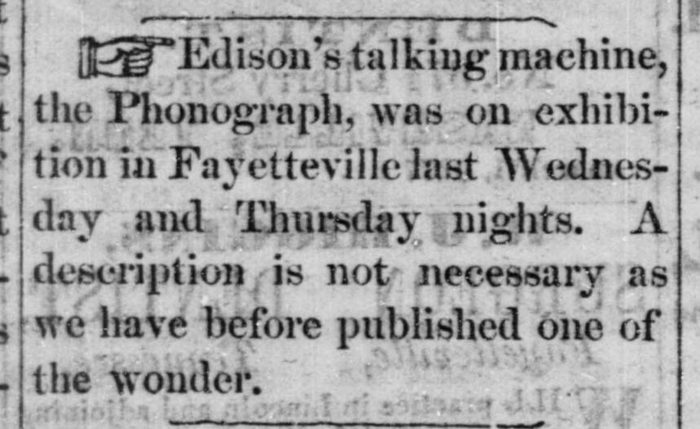
1879 newspaper item: Edison’s talking machine, the phonograph, was on exhibition in Fayetteville
Fayetteville Observer, July 10, 1879, p. 3. Library of Congress, Chronicling America (public domain). Cropped.
See the answer
Edison’s phonograph, “on exhibition in Fayetteville last Wednesday and Thursday nights” (July 2 and 3, 1879). The editor skipped a description: “we have before published one of the wonder.” It was brand new. The Library of Congress says the first phonograph was finished in December 1877 and patented Feb. 19, 1878. The poster for the show survives; see the archive posters below.

Still open: What did people in Fayetteville say or play into it? Nobody wrote it down that we’ve found.

Source: Fayetteville Observer, July 10, 1879, p. 3 · Library of Congress: History of the cylinder phonograph

Dig deeper: See the 1879 poster

Evidence locker: newspaper clippings: Fayetteville Observer 1866–1880, Library of Congress (public domain)

Send us your old photo of the square. It could become a Square Detective case. Share a photo or email hello@ourtownalmanac.com. Only send photos you own or have the owner’s OK to share. Tell us how you’d like to be credited (initials, “a reader,” or your name). Loaned photos stay yours.

Case #11: New from the archive: posters printed on the square

Three posters from the Tennessee State Library and Archives. Each was printed for people standing right where you can stand today.

Open case

Read the poster. “Will exhibit to-night at ____ on ____.” Why would a printer leave the place and date blank?
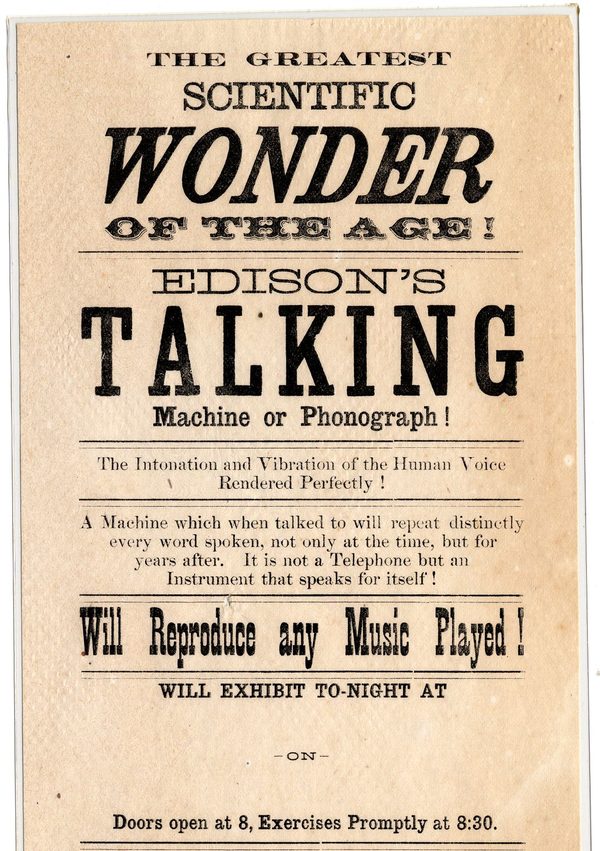
1879 poster: The Greatest Scientific Wonder of the Age, Edison’s Talking Machine. It is not a telephone, and will reproduce any music played
“The Greatest Scientific Wonder of the Age: Edison’s Talking Machine,” poster dated July 3, 1879. Tennessee State Library and Archives, Broadsides Collection (No Copyright – United States). Cropped; the printed names at the bottom are left out.
Our best guess
Our guess: so the same poster could be used night after night, with the place written in by hand. That’s a guess, not a fact. The poster is dated “Fayetteville, July 3rd, 1879,” and was printed at the Observer office. A printed note at the bottom (cropped here) says the machine was shown “last evening” in a hall in town, which lines up with the newspaper’s “last Wednesday and Thursday nights.”

Source: TSLA broadside record · Fayetteville Observer, July 10, 1879, p. 3

Dig deeper: The newspaper item · Make your case

What does it suggest?

The poster says “It is not a Telephone.” Why would it need to say that?

See the answer
Both were new. The Library of Congress dates Bell’s telephone sketches to 1876 and the first phonograph to December 1877. In 1879, a machine that talked could easily be mistaken for the other new machine that talked. The poster also promised it “Will Reproduce any Music Played!” Admission: 25 cents, children 15.

Source: TSLA broadside record · Library of Congress: History of the cylinder phonograph · Library of Congress: Bell and the telephone

Dig deeper: What would you have recorded? Tell us

Question

October 1882. The town passed a new rule and printed it as a poster. Guess first: where did it become a misdemeanor to be drunk?
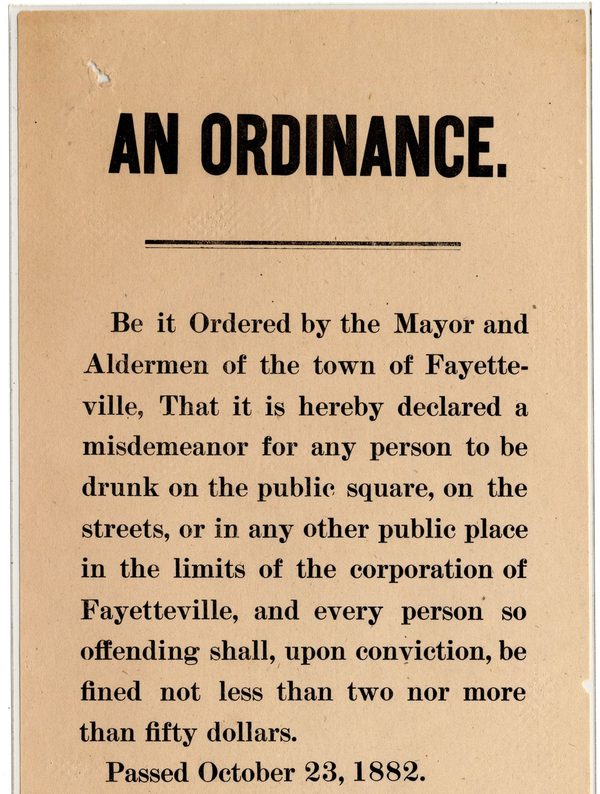
1882 printed town ordinance making it a misdemeanor to be drunk on the public square, fined two to fifty dollars
“An Ordinance,” passed Oct. 23, 1882. Tennessee State Library and Archives, Broadsides Collection (No Copyright – United States). Cropped; the signatures are left out.

Read the first lines of the ordinance.

See the answer
“On the public square, on the streets, or in any other public place.” The fine: “not less than two nor more than fifty dollars.” Passed Oct. 23, 1882.

Source: TSLA broadside record

Dig deeper: Who sold whiskey on the square in 1887?

Open case

Why print a town ordinance as a poster? Where would you have hung it?

What we know so far
A poster reaches people who don’t take the paper. Where this one was posted, and what led to it that fall, we haven’t found. We don’t know. Do you?

Source: TSLA broadside record

Dig deeper: Make your case

Open case

1867. A new store on the square sells only “for Cash or Barter.” What would you bring to trade?
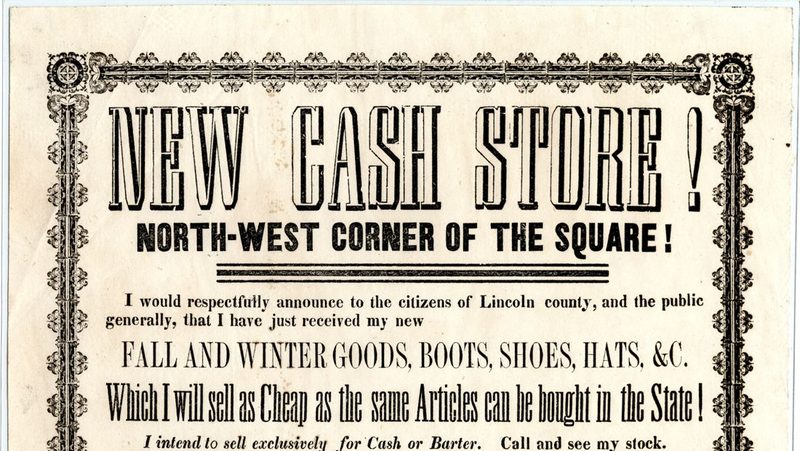
1867 poster: New Cash Store, North-West Corner of the Square, fall and winter goods, boots, shoes, hats
“New Cash Store! North-West Corner of the Square!” poster, 1867 (date from the archive record). Tennessee State Library and Archives, Broadsides Collection (No Copyright – United States). Cropped above the owner’s name and date line.
What we know so far
Barter means paying in goods instead of money. What customers actually brought in, the poster doesn’t say. The poster promises fall and winter goods, boots, shoes and hats, sold “as Cheap as the same Articles can be bought in the State!” We don’t know what people traded. Do you?

Source: TSLA broadside record

Dig deeper: Before the cash store: the town scales · Tell us

What does it suggest?

Why would a store make a point of being a “cash store” in 1867?

What we know so far
The poster doesn’t explain. One possibility is that it was a change from selling on credit, but that’s a guess. We don’t know. Do you?

Source: TSLA broadside record

Dig deeper: Make your case

Evidence locker: broadsides: 1867 cash store, 1879 phonograph, 1882 ordinance (TSLA, No Copyright – United States)

Send us your old photo of the square. It could become a Square Detective case. Share a photo or email hello@ourtownalmanac.com. Only send photos you own or have the owner’s OK to share. Tell us how you’d like to be credited (initials, “a reader,” or your name). Loaned photos stay yours.

Case #12: Clues you can still see today

Some evidence never made it into an archive. It’s still on the buildings. Stand on the spot and look.

Clue you can still see

Stand in front of 114 and 116 College St. E. and look at the second floor. What’s covering it?

What we know so far
Metal panels. They cover the upper floors in both the 2008 and 2015 photos we have. What’s behind them, and when they went up, we don’t know. Next door, 112 College St. E. still shows three round-arched upper windows.

Source: 2008 and 2015 square photos on Wikimedia Commons (as used on our north side page)

Dig deeper: Have a photo from before the panels? Send it · 114 College St. E.

Go look and tell us

Walk to the southeast corner of the courthouse lawn. Any sign of an 1870s well?

What we know so far
We don’t know. The 1878 boring was “near the south-east corner of the building,” but that was the old courthouse, not today’s. Go look and tell us what you find.

Source: Fayetteville Observer, Feb. 7, 1878, p. 3

Dig deeper: Tell us what you see

Go look and tell us

Ghost signs, date stones, names in cornices, tile in doorways, iron storefront maker plates, hitching rings, old step stones, painted-over letters: which ones are still on the square?

What we know so far
We haven’t seen any of these in the current photos we have, so this one is yours. Walk the four sides, look up and look down, and send us a photo of anything that looks older than the store. It could become a Square Detective case.

Dig deeper: Send a photo · Email us

Evidence locker: physical traces: 2008 and 2015 photos (north side) · newspaper: 1878 well boring

Send us your old photo of the square. It could become a Square Detective case. Share a photo or email hello@ourtownalmanac.com. Only send photos you own or have the owner’s OK to share. Tell us how you’d like to be credited (initials, “a reader,” or your name). Loaned photos stay yours.

Case #13: Bigger picture

What was going on beyond the square when these were made?

Question

Who was president when each of these was made?

See the answer
1886 photo: Grover Cleveland. 1909 postcard (mailed July 31, 1909): William Howard Taft. 1911 parade: Taft. 1914 map: Woodrow Wilson. 1926 map: Calvin Coolidge. For more on what was happening in each map year, see the year notes on the old-maps pages.

Source: Miller Center, University of Virginia: U.S. presidents

Dig deeper: The square through the decades

Question

In 1887 the square sold dry goods, groceries and whiskey. Today it’s lawyers, salons and shops. What happened in between?

See the answer
Follow the clues decade by decade on the square page: map labels from 1887 to 1926, then today’s storefronts. Railroads, horses, the end of the saloons, cars and a new courthouse are all suspects. Make your case.

Source: The square through the decades

Dig deeper: The square through the decades

Evidence locker: context: presidents by year · map labels: 1887–1926 tally

Send us your old photo of the square. It could become a Square Detective case. Share a photo or email hello@ourtownalmanac.com. Only send photos you own or have the owner’s OK to share. Tell us how you’d like to be credited (initials, “a reader,” or your name). Loaned photos stay yours.

Back to every building on the square · Walking tour

Square Detective looks at the past. Business Detective looks at today. Try a noticing walk past today’s shops: Business Detective walk

A new case each week. The answer comes Friday.

Optional, so we can greet you by name. Only email is required.

Free. We’ll email you a link to confirm; you’re subscribed once you click it. Sent through Brevo, our email service. See privacy.

Free · unsubscribe anytime